The Tai Chi Walk: Building Balance, Strength, and Calm from the Ground Up

The Tai Chi Walk: Building Balance, Strength, and Calm from the Ground Up

One of the most powerful — and often overlooked — practices in Tai Chi is the Tai Chi walk. At first glance, it may look like “just walking slowly,” but in reality, it is a deeply intentional movement practice that trains the body, brain, and nervous system all at once.

The Tai Chi walk begins from the ground up, teaching us how to shift weight safely, root through the feet, and move with awareness and ease.


Tai Chi Walking
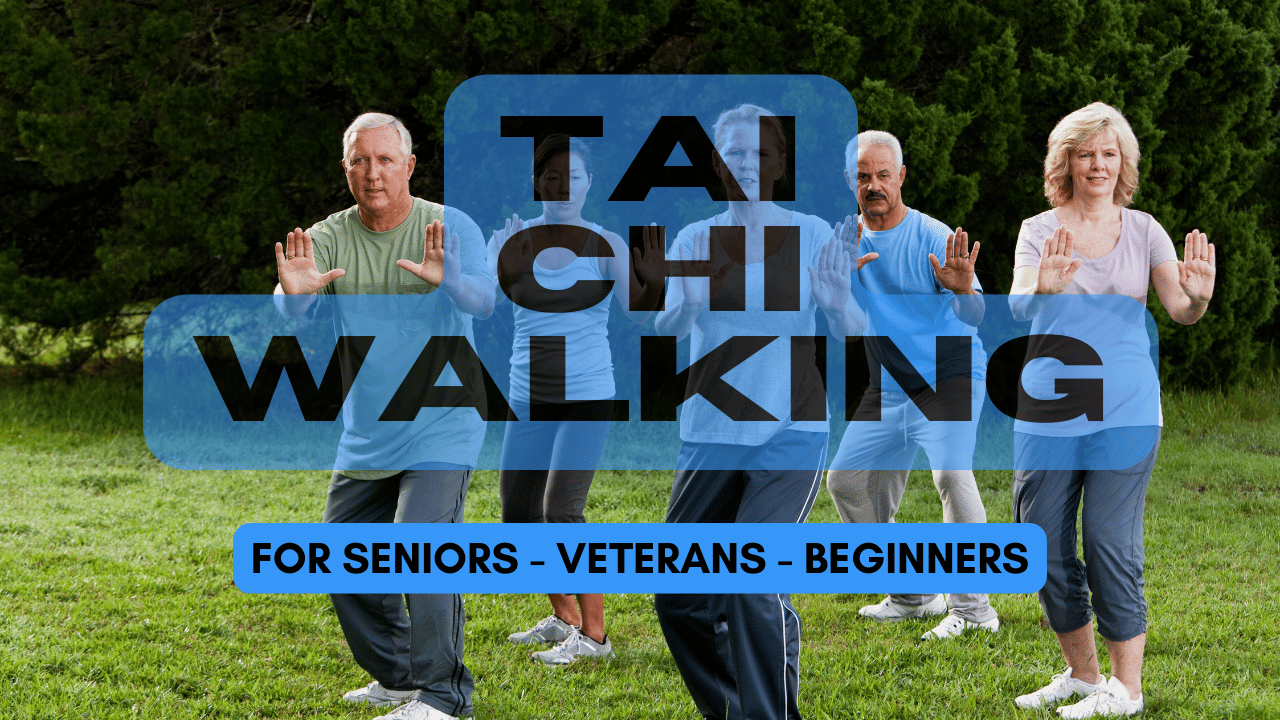
People move forward in a Tai Chi walk, placing each foot with care as their weight transfers smoothly from back leg to front leg. Their posture is upright yet relaxed, hips gently turning, arms floating naturally as they remain centered and grounded.

What Is the Tai Chi Walk?

In the Tai Chi walk, we move through a series of small, deliberate steps:

  • Feet begin together
  • Knees gently bend as the weight settles downward
  • One foot opens to about 45 degrees
  • The body spirals through the leg
  • A short step places the heel down, toes forward
  • Hips turn forward into a front stance
  • Weight transfers smoothly from back leg to front leg

In the final position, about 70% of the weight rests on the front leg, while the back foot stays grounded at a 45° angle. The movement repeats on both sides, creating a steady rhythm of shift → step → turn → transfer.

This slow, mindful pace is where the magic happens.


Physical Benefits of the Tai Chi Walk

🦵 Stronger Legs and Healthier Joints

The Tai Chi walk gently strengthens:

  • Ankles
  • Knees
  • Hips
  • Thighs and glutes

Because the steps are short and controlled, the joints learn to support weight safely without strain, making this practice especially valuable for aging bodies.


⚖️ Improved Balance and Fall Prevention

Each step trains single-leg balance and controlled weight shifting. Over time, this improves proprioception — your body’s ability to sense where it is in space.

This is one of the reasons Tai Chi is widely recommended for:

  • Seniors
  • People recovering from injury
  • Anyone concerned about stability and confidence while walking

🌱 Rooting and Grounding

A key Tai Chi principle is often described as:

“Feet rooted into the ground, bottom heavy, top light.”

The Tai Chi walk reinforces this by teaching the body to:

  • Feel stable and supported from the feet
  • Release unnecessary tension in the upper body
  • Move from a centered, grounded place

This grounding effect can be both physically stabilizing and emotionally calming.


Brain and Nervous System Benefits

🧠 Brain–Body Coordination

The Tai Chi walk is not automatic movement. It requires:

  • Attention to sequencing
  • Awareness of foot placement and hip rotation
  • Coordination between upper and lower body

This kind of mindful movement supports brain health and neuroplasticity, helping keep the mind engaged and adaptable.


🌬️ Nervous System Regulation

The slow, rhythmic pace of Tai Chi walking naturally supports the parasympathetic nervous system — the “rest and restore” mode of the body.

Many people notice:

  • Reduced stress
  • Calmer breathing
  • A sense of being more centered and present

It’s movement that soothes rather than overstimulates.


Energetic and Meditative Qualities

From a Tai Chi and Qigong perspective, the spiraling through the legs and smooth weight transfer helps encourage healthy energy (Qi) flow throughout the body.

The walk becomes a form of moving meditation:

  • Focused, but relaxed
  • Grounded, yet light
  • Strong, without force

Why the Tai Chi Walk Matters

The Tai Chi walk teaches us how to move through life more safely and gracefully, not just how to exercise. Every step becomes practice for:

  • Walking with confidence
  • Turning without losing balance
  • Moving with awareness rather than habit

Whether you are new to Tai Chi or have practiced for years, returning to the Tai Chi walk is always worthwhile. It reminds us that stability, strength, and calm all begin at our feet.

Yang Style Short Form 12 — A Closing Practice For Integration And Calm

Yang Style Short Form 12: A Gentle Closing Practice for Integration and Calm

Over the past months of teaching Gentle Yoga for Back Care and Chair Tai Chi, I’ve noticed something beautiful happen when we give ourselves just a few extra minutes at the end of class — a chance to integrate what the body has learned.

To support that integration, I’ve begun adding a short Yang Style Tai Chi Short Form 12 practice at the close of both classes. This brief sequence acts like a soft bow to the work we’ve done together — steadying the nervous system, organizing balance, and helping movement settle into the body with ease.


Why End Class with Yang Style Short Form 12?

Whether you’ve been practicing on the mat for back care or seated for Chair Tai Chi, your body has already been exploring:

  • Spinal length and gentle rotation
  • Weight shifting and postural awareness
  • Coordinated upper- and lower-body movement
  • Breath-led pacing and mindful attention

The Short Form 12 brings all of these elements together in a flowing, accessible way. Rather than introducing something abrupt or demanding, it offers continuity — a calm transition from structured learning into embodied understanding.


What Makes the Short Form 12 So Supportive

This Yang Style form was designed to be concise yet complete. In just a few minutes, practitioners experience:

  • Transitional movements that refine balance and coordination
  • Gentle turns and weight shifts that challenge awareness without strain
  • Intentional foot placement (even when adapted for chair practice)
  • Continuous flow that quiets the mind while awakening the body

For many students — especially seniors, Veterans, and absolute beginners — this form offers a sense of accomplishment without overwhelm.


How It Complements Gentle Yoga for Back Care

After yoga-based movements that focus on spinal support, hip mobility, and muscular balance, the Short Form 12:

  • Encourages upright, functional posture
  • Reinforces smooth transitions between movements
  • Helps the nervous system shift from effort into ease
  • Supports the body in carrying new movement patterns into daily life

Think of it as the bridge between therapeutic movement and everyday motion.


How It Enhances Chair Tai Chi Practice

For Chair Tai Chi students, the Short Form 12 is thoughtfully adapted:

  • Movements are simplified while preserving Tai Chi principles
  • Weight shifts become energetic rather than load-bearing
  • Upper-body coordination remains active and expressive
  • Breath, intention, and imagery stay central

This allows seated practitioners to experience the essence of Tai Chi flow — without needing to stand or strain.


A Few Minutes That Make a Big Difference

Adding this short practice at the end of class has consistently resulted in:

  • Greater calm and groundedness
  • Improved balance awareness
  • A clearer sense of completion
  • Students leaving class feeling organized rather than rushed

It’s a reminder that how we finish matters.


Closing Thought

Tai Chi isn’t about memorizing choreography — it’s about learning how to move through life with steadiness, awareness, and grace.

By closing our Gentle Yoga for Back Care and Chair Tai Chi classes with the Yang Style Short Form 12, we give the body and mind a chance to absorb, integrate, and rest into what’s been learned.

A small practice. A quiet ending. A lasting effect.

Gail Pickens-Barger

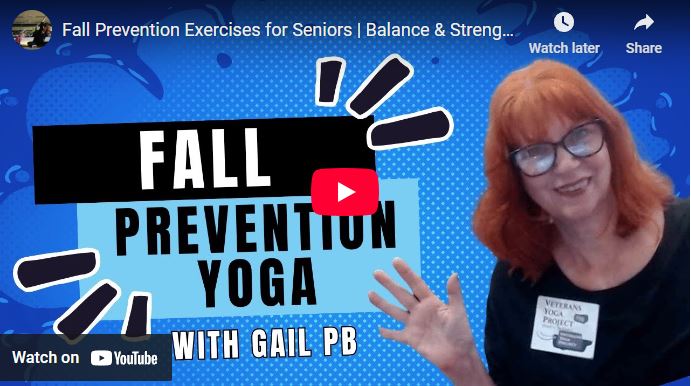
Fall Prevention Chair Yoga – Sequences for successful strengthening and balancing to prevent falls with Gail Pickens-Barger

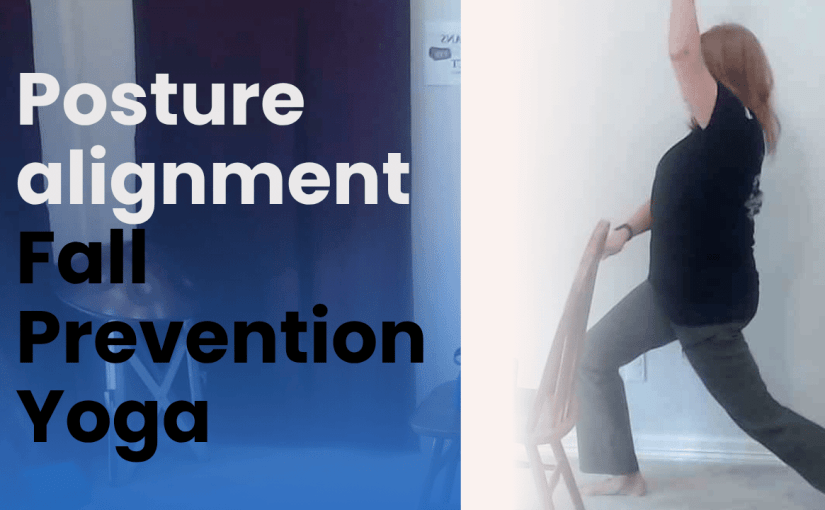
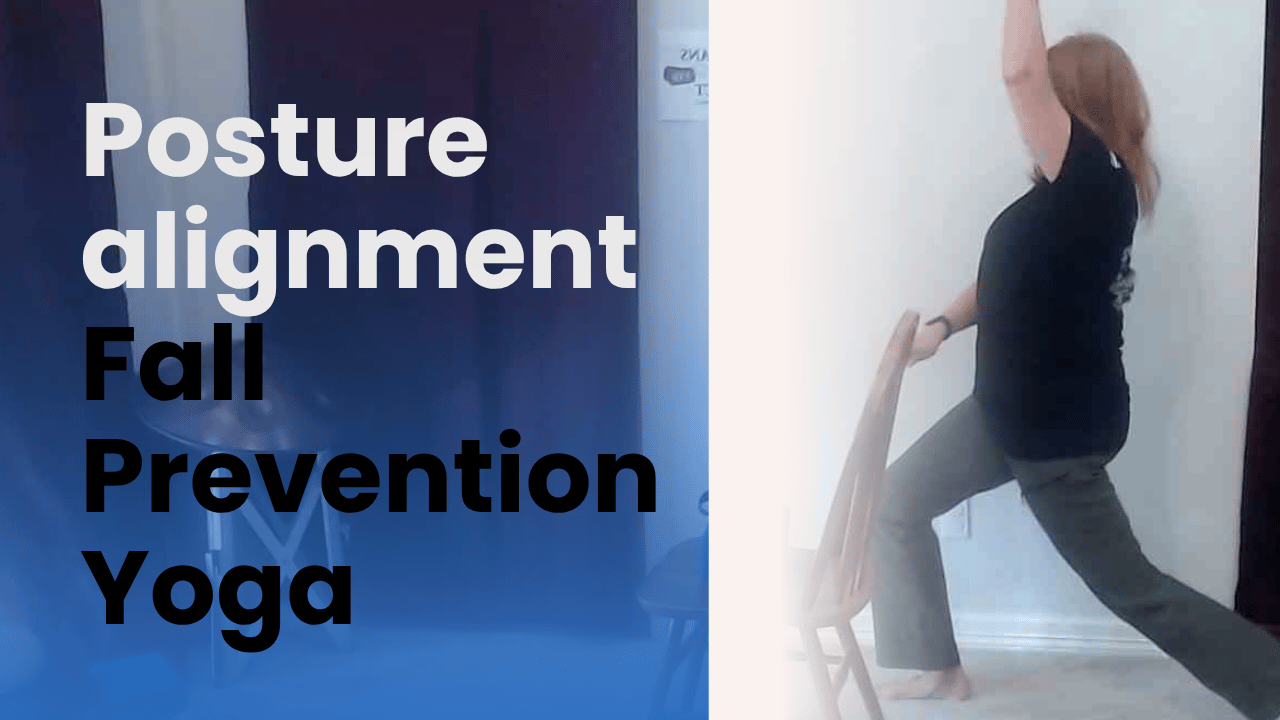
Introduction to Fall Prevention Yoga

Posture alignment, pilates, yoga, tai chi, chair tai chi simple movements to effectively strengthen and balancing for preventing falls, with instructor Gail Pickens-Barger

Overview of Chair Yoga

  • Chair yoga is a modified form of yoga that allows individuals to perform poses while seated or using a chair for support, making it accessible for those with mobility issues.
  • It focuses on improving flexibility, strength, and balance, which are crucial for fall prevention, especially in older adults.
  • The practice can be adapted to various skill levels, ensuring inclusivity for all participants.

Importance of Postural Alignment

  • Proper postural alignment is essential for maintaining balance and preventing falls; it involves aligning the body in a way that reduces strain and enhances stability.
  • Misalignment can lead to muscle imbalances and increase the risk of falls, making awareness of body positioning critical during yoga practice.
  • Techniques such as checking foot alignment and engaging core muscles are emphasized to promote better posture.

Breathing Techniques in Chair Yoga

Breath Awareness and Control

  • Breath is a foundational element in yoga; it helps to center the mind and body, enhancing the overall practice.
  • Participants are guided to focus on their breath by placing hands on the belly and chest to feel the movement during inhalation and exhalation.
  • Techniques such as breathing through the nose are encouraged to promote relaxation and prevent throat dryness.

Exercises for Breath Expansion

  • Exercises include expanding the belly during inhalation and drawing the belly button towards the spine during exhalation, which helps engage the core.
  • Participants are encouraged to visualize their breath filling up their abdomen like a balloon, promoting deeper breathing and relaxation.
  • Regular practice of these techniques can improve lung capacity and overall respiratory health.

Postural Alignment Exercises

Key Alignment Techniques

  • Participants are instructed to ensure their feet are parallel and aligned, which is crucial for maintaining balance during standing poses.
  • Exercises include squeezing the gluteal muscles to engage the core and improve stability, which can be practiced multiple times for effectiveness.
  • The modified golfer’s grip is introduced to enhance upper body strength and posture, focusing on the alignment of the arms and shoulders.

Dynamic Movements for Stability

  • Movements such as interlacing fingers and reaching overhead help to stretch and strengthen the upper body while maintaining a stable base.
  • Participants are guided through sequences that involve bending and straightening the knees to promote joint mobility and strength.
  • Incorporating hip circles and shoulder movements helps to lubricate joints and improve overall flexibility, which is essential for fall prevention.

Conclusion and Practice Integration

Importance of Regular Practice

  • Consistent practice of chair yoga can lead to improved balance, strength, and flexibility, significantly reducing the risk of falls in older adults.
  • Participants are encouraged to integrate these exercises into their daily routines for maximum benefit.
  • The holistic approach of combining breath work, alignment, and movement fosters a greater sense of well-being and confidence.

Community and Support

  • Engaging in group classes can provide social support, which is beneficial for mental health and motivation to continue practicing yoga.
  • Instructors play a crucial role in guiding participants through safe practices and modifications tailored to individual needs.
  • Building a community around chair yoga can enhance the experience and encourage participants to share their progress and challenges.

Introduction to Movement and Energy Techniques

Overview of Movement Practices

  • Movement practices focus on enhancing physical health and energy flow in the body.
  • Techniques often incorporate elements from traditional practices such as Tai Chi and Qi Gong.
  • Emphasis on mindful movement to promote relaxation and reduce tension.

Importance of Energy Flow

  • Energy flow is crucial for overall health, as blockages can lead to physical and mental issues.
  • Traditional Chinese Medicine identifies meridians that correspond to different organs and energy pathways.
  • Techniques such as tapping and stroking are used to stimulate these meridians and promote healing.

Detailed Techniques for Energy Release

Upper Body Movements

  • Arm Circles: Helps to release tension in the upper back and shoulders. Recommended to perform in sets of 10, alternating directions.
  • Golfer’s Grip: Engages the arms and shoulders, promoting flexibility and strength.

Detox Techniques

  • Chon Detox: Involves stroking across the collarbone to clear energy blockages in the lung, kidney, and stomach meridians.
  • Ear and Jawline Strokes: Stimulates cerebral spinal fluid flow, potentially reducing dementia risk.

Lower Body and Foot Techniques

Foot and Ankle Exercises

  • Point and Flex: Engages the calf muscles, considered the ‘second heart’ of the body, aiding in blood circulation.
  • Ankle Circles: Strengthens the feet and improves mobility, essential for walking stability.

Knee and Leg Movements

  • Gallbladder Meridian Tapping: Tapping the side of the knees can help alleviate knee pain and improve circulation.
  • Leg Shaking: Promotes oxygen flow to the lower body, reducing the risk of leg cramps.

Balancing Techniques and Final Movements

Golden Rooster Balance Exercise

  • Golden Rooster: A Tai Chi exercise that enhances balance and stability, focusing on rooting down through one leg while lifting the other.
  • Encourages awareness of body alignment and core engagement.

Conclusion and Daily Practice Recommendations

  • Incorporating these techniques into daily routines can enhance physical health and energy levels.
  • Recommended to practice each technique 5-10 times for optimal benefits.

Tai Chi Concepts and Techniques

Rooting and Balance

  • The concept of rooting in Tai Chi emphasizes grounding oneself, particularly through the leg closest to a support (like a chair).
  • Practitioners are encouraged to assess their need for support while performing movements, enhancing awareness of balance and stability.
  • The exercise involves bending the knees and tucking the tailbone, which helps in maintaining a strong posture and balance.
  • A three-point step drill is introduced to build leg strength and improve balance awareness, involving movements forward, to the side, and backward.
  • The importance of feeling sensations in the hips and legs during these movements is highlighted, indicating engagement of muscle groups.
  • Repetition of these movements helps in muscle memory and strength building, essential for Tai Chi practice.

Movement Sequences

  • The sequence involves bending both knees and performing a series of leg movements while maintaining balance, such as bringing the leg forward, to the side, and back.
  • Each movement is performed with a focus on maintaining the weight on the rooted leg, ensuring stability and control.
  • The exercise encourages participants to engage their core and leg muscles, promoting overall strength and flexibility.
  • The sequence is repeated multiple times to reinforce muscle engagement and improve coordination.
  • Participants are encouraged to notice any muscle buildup and to release tension through gentle movements like step touches.
  • The integration of music or rhythm (e.g., 106 beats) can enhance the experience and encourage synchronization of movements.

Strength Training Techniques

Chair Exercises and Equipment Use

  • The transition to strength training involves using a chair, yoga block, and strap to facilitate various exercises.
  • A cat-cow stretch is introduced to warm up the spine, emphasizing the importance of spinal flexibility and posture.
  • The use of a yoga strap is demonstrated, showing how to create resistance and engage muscles effectively during exercises.
  • Participants are instructed to maintain a specific distance between their hands on the strap, promoting proper alignment and engagement of the legs and core.
  • The concept of pressing down into the floor while engaging the legs is emphasized, creating a strong foundation for strength training.
  • The importance of breathing during exercises is highlighted, encouraging participants to focus on their breath to enhance performance.

Advanced Strength Techniques

  • The use of a yoga block between the thighs is introduced to enhance inner thigh strength and stability during exercises.
  • Participants are instructed to press against the block while maintaining control, which helps in building muscle strength without losing form.
  • The session includes vigorous movements, such as drumming with fists, to engage the upper body and improve coordination.
  • Emphasis is placed on maintaining a strong core and proper posture throughout the exercises to prevent injury.
  • The session concludes with stretches targeting the big toe and foot flexibility, which are often neglected but crucial for overall mobility.
  • Variations of warrior poses and lunges are suggested to further enhance flexibility and strength in the lower body.

Introduction to Chair Yoga

Overview of Chair Yoga

  • Chair yoga is a form of yoga that can be practiced while seated in a chair, making it accessible for individuals with mobility issues or those who spend long hours sitting.
  • It incorporates traditional yoga postures and breathing techniques, adapted for a seated position to enhance flexibility, strength, and relaxation.
  • This practice is beneficial for improving posture, reducing stress, and promoting overall well-being, especially for those with limited mobility.
  • Chair yoga can be practiced in various settings, including homes, offices, and community centers, making it a versatile option for many individuals.
  • The use of a chair provides stability and support, allowing practitioners to focus on their breath and body alignment without the fear of falling.
  • Regular practice can lead to improved circulation, reduced tension, and increased range of motion in the joints.

Benefits of Chair Yoga

  • Enhances flexibility and strength, particularly in the lower body, which is crucial for maintaining mobility as one ages.
  • Reduces the risk of injury by promoting safe movement patterns and improving balance.
  • Supports mental health by reducing anxiety and stress through mindful breathing and movement.
  • Encourages social interaction and community building when practiced in group settings.
  • Provides a gentle introduction to yoga for beginners or those recovering from injury.
  • Can be easily modified to accommodate various physical limitations or health conditions.

Chair Yoga Techniques

Warrior One and Crescent Lunge Variations

  • Begin by sitting tall in the chair, ensuring your back is straight and your feet are flat on the ground.
  • Lift your hips slightly off the chair, allowing your body to engage and activate the core muscles.
  • Extend one leg forward, keeping the toe pointed and pressing into the floor with the back foot for stability.
  • Optionally, raise your arms overhead to deepen the stretch and engage the upper body.
  • Focus on breathing deeply, feeling the stretch in the hip flexors and lower back as you hold the position.
  • This pose can increase heart rate and improve circulation, making it a dynamic addition to the practice.

Unsupported Twists for Spinal Mobility

  • Start in a seated position with feet hip-width apart and hands in a ‘W’ shape to support the upper body.
  • Inhale deeply, expanding the chest and belly, then exhale as you twist to one side, keeping the legs stable.
  • Maintain awareness of the knees, ensuring they do not drop inward during the twist to protect the joints.
  • Hold the twist for several breaths, feeling the stretch in the spine and shoulders, then return to center.
  • Repeat on the opposite side, focusing on the breath and the sensations in the body.
  • This exercise promotes spinal flexibility and aids in digestion through gentle twisting movements.

Additional Movements and Considerations

Hip Joint Mobilization

  • Engage in seated movements to ‘oil’ the hip joints, such as lifting the knee up and out to the side.
  • Incorporate gentle stomping motions to release tension and promote circulation in the lower body.
  • Be mindful of any discomfort, especially for individuals with conditions like plantar fasciitis or brittle bones.
  • Encourage participants to listen to their bodies and modify movements as necessary to avoid strain.
  • This practice can help maintain joint health and prevent stiffness from prolonged sitting.
  • Regular hip mobilization can enhance overall mobility and ease of movement in daily activities.

Standing Exercises for Strength and Balance

  • Transition to standing by moving behind the chair for support, ensuring a stable base with feet hip-width apart.
  • Perform leg swings to engage the hip flexors and improve balance, alternating sides for symmetry.
  • Introduce heel out and toe in movements to challenge coordination and strengthen the lower body.
  • Emphasize the importance of maintaining a strong core and proper posture throughout the exercises.
  • Encourage hydration and breaks during practice, especially after prolonged sitting, to maintain energy levels.
  • These standing exercises can enhance strength, balance, and overall functional fitness.

Movement Techniques for Flexibility and Strength

Dynamic Stretching and Muscle Engagement

  • The importance of dynamic stretching in preparing the body for movement, particularly focusing on large muscle groups.
  • Techniques include stepping back with one leg while bending the knee of the other leg, which engages the calf muscles and promotes flexibility.
  • Emphasis on pressing the back heel into the ground to enhance calf muscle stretching and overall stability.
  • Incorporating arm movements (raising arms) to increase heart rate and engage upper body muscles during stretches.
  • Example: Performing a back bend while stepping back can stimulate heart rate and promote bone growth.
  • Historical context: Dynamic stretching has been used in various cultures as a warm-up technique before physical activities.

Sciatica Soother Techniques

  • Introduction to the ‘sciatica soother’ as a targeted exercise to alleviate discomfort in the sciatic nerve.
  • Steps include stepping back, lifting the back heel, and tucking the pelvis under to engage core muscles.
  • Importance of maintaining a soft bend in the knee of the front leg to avoid strain while performing the exercise.
  • Notable sensations: Participants may experience shaking or discomfort, indicating muscle engagement and stretching.
  • Example: Flossing the sciatic nerve through specific movements can help relieve tension and improve mobility.
  • Case study: Many physical therapists recommend similar movements for patients with sciatica to enhance recovery.

Walking Techniques for Balance and Coordination

  • Walking forwards and backwards as a method to improve balance and coordination, utilizing a chair or wall for support.
  • The heel-toe walking technique is emphasized for better stability and muscle engagement.
  • Switching foot positions during walking exercises challenges the brain and enhances cognitive function related to movement.
  • Example: Walking backwards engages different brain pathways, beneficial for prefrontal cortex development.
  • Safety note: Always use a stable support when practicing these movements to prevent falls.
  • Historical reference: Walking exercises have been used in rehabilitation settings for centuries to improve mobility.

Strength and Endurance Assessment

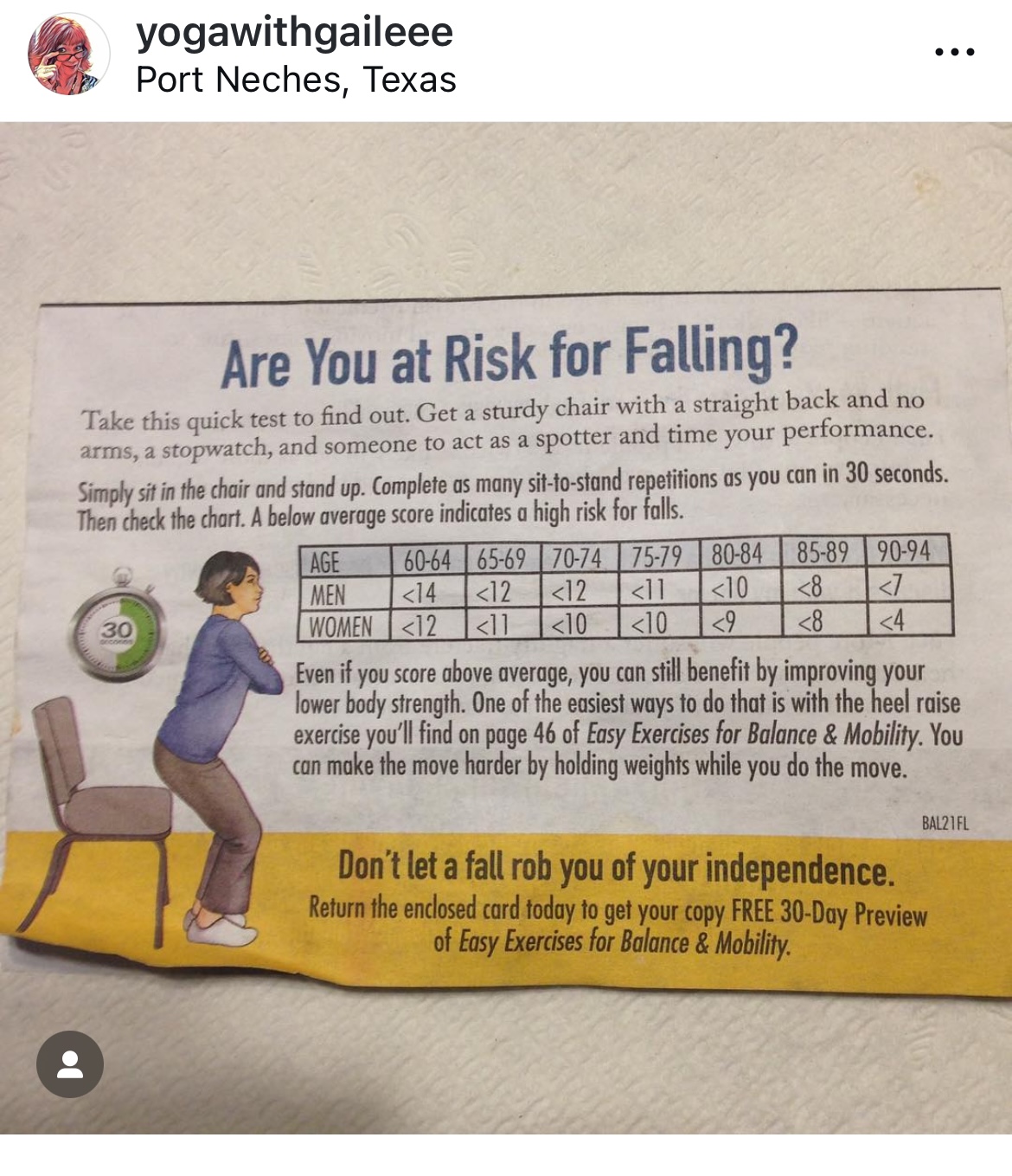
Are You at Risk of Falling?

Sit to Stand Exercise

  • The sit-to-stand exercise is a key indicator of lower body strength and fall risk assessment.
  • Guidelines suggest that completing 10-12 repetitions in 30 seconds indicates a lower risk of falls.
  • Proper technique involves placing hands on shoulders or the chair for support, ensuring safety during the exercise.
  • Example: If a participant can only perform 4 repetitions, they may have a 70% chance of falling, highlighting the importance of strength training.
  • Training modifications: Beginners may start with hands on the chair to build strength gradually.
  • Historical context: This exercise has been widely adopted in geriatric fitness programs to assess and improve functional mobility.

Heart Rate and Breathing Techniques

  • The relationship between physical activity and heart rate increase, emphasizing the importance of monitoring heart rate during exercises.
  • Techniques for relaxation include guided breathing exercises to lower heart rate and promote calmness.
  • Example: The ‘non-sleep deep rest’ (NSDR) meditation technique encourages participants to focus on their breath, enhancing relaxation.
  • Breathing patterns: Inhale deeply through the nose and exhale through the mouth to relieve stress and tension.
  • Historical reference: Breathing techniques have been integral to various meditation practices across cultures for centuries.
  • Importance of awareness: Noticing one’s breath can enhance mindfulness and overall well-being.

Understanding Non-Sleep Deep Rest (NSDR)

The Concept of NSDR

  • Non-Sleep Deep Rest (NSDR) is a practice that promotes relaxation and mindfulness without the need for sleep.
  • It involves techniques such as breath awareness and body scanning to enhance present-moment awareness.
  • NSDR can help reduce stress, improve focus, and enhance overall well-being by allowing the body to rest deeply while remaining awake.
  • The practice encourages participants to notice their breath without altering it, fostering a sense of calm and presence.
  • Historical context: NSDR techniques are rooted in ancient practices such as yoga and meditation, which emphasize the importance of breath and body awareness.

Breath Awareness Techniques

  • Participants are guided to focus on their breath, noticing the sensations of inhaling and exhaling.
  • The practice encourages slow, deep breathing, which can activate the parasympathetic nervous system, promoting relaxation.
  • Example: The ‘elongated breath’ technique involves inhaling deeply and exhaling slowly, often counted to enhance focus and control.
  • Breathing exercises can be integrated into daily routines to manage stress and improve cognitive function.
  • Case Study: Research shows that breath awareness can significantly reduce anxiety levels in participants.

Body Awareness and Scanning

Guided Body Scan

  • The body scan technique involves directing attention to various parts of the body, promoting relaxation and awareness.
  • Participants are invited to notice sensations in specific body areas, such as fingers, arms, and legs, fostering a connection between mind and body.
  • This practice helps in identifying areas of tension or discomfort, allowing for targeted relaxation.
  • Example: The guided journey through the body includes focusing on the right and left sides, enhancing bilateral awareness.
  • Historical context: Body scanning is a common practice in mindfulness meditation, used to cultivate awareness and acceptance of bodily sensations.

Visualization Techniques

  • Visualization is used to enhance relaxation, such as imagining bright sunshine saturating the body, promoting healing and warmth.
  • This technique can help participants release tension and negative energy, fostering a sense of peace.
  • Example: Inviting ‘healing sunshine’ into areas of discomfort can create a mental image of warmth and relief.
  • Visualization can be a powerful tool in stress management and emotional regulation.
  • Research indicates that guided imagery can improve physical and emotional health outcomes.

Movement and Physical Awareness

Importance of Movement

  • Regular movement is emphasized to prevent physical discomfort and promote overall health, especially during prolonged sitting.
  • Simple movements, such as shoulder circles and seated cat-cow stretches, can alleviate tension and improve posture.
  • Example: The practice encourages participants to move every hour to maintain spinal health and cognitive function.
  • Historical context: Movement practices are integral to many wellness traditions, emphasizing the connection between physical activity and mental clarity.
  • Case Study: Studies show that incorporating movement into daily routines can enhance productivity and reduce fatigue.

Chair Yoga Practices

  • Chair yoga is a modified form of yoga that can be practiced while seated, making it accessible for individuals with mobility challenges.
  • The practice includes gentle stretches and movements that promote flexibility and strength without the need for a mat.
  • Example: ‘Swimming dragon’ and ‘spread the feathers’ are specific chair yoga exercises that enhance range of motion in the neck and shoulders.
  • Chair yoga can be particularly beneficial for older adults or those recovering from injury, providing a safe way to engage in physical activity.
  • Historical context: Chair yoga has gained popularity as a therapeutic approach to enhance mobility and well-being in various populations.

Mindfulness and Gratitude Practices

Cultivating Mindfulness

  • Mindfulness is the practice of being present and fully engaged in the moment, which can be enhanced through guided exercises.
  • Participants are encouraged to focus on their breath and bodily sensations, fostering a deeper connection to the present.
  • Example: The practice of noticing one’s breath and body can lead to increased awareness and reduced stress levels.
  • Mindfulness techniques can be integrated into daily life to improve emotional regulation and resilience.
  • Research indicates that mindfulness practices can lead to significant improvements in mental health outcomes.

Gratitude Practice

  • Gratitude practices involve reflecting on positive aspects of life, which can enhance overall well-being and happiness.
  • Participants are guided to think of something they are grateful for, fostering a positive mindset.
  • Example: Clasping hands at heart center while reflecting on gratitude can create a physical representation of appreciation.
  • Gratitude practices have been shown to improve emotional health and strengthen social connections.
  • Historical context: Gratitude has been a focus in various philosophical and spiritual traditions, emphasizing its role in personal growth and community building.

Additional thoughts to share.

Key Terms/Concepts

  • Chair Yoga: A form of yoga that can be done while seated in a chair, making it accessible for individuals with mobility issues.
  • Postural Alignment: The proper positioning of the body to maintain balance and prevent injury during movement.
  • Breath Awareness: The practice of focusing on the breath to enhance relaxation and mindfulness during yoga.
  • Lymphatic Drainage: Techniques used to stimulate the lymphatic system to promote detoxification and improve circulation.
  • Non-Sleep Deep Rest (NSDR): A meditation practice that promotes relaxation and recovery without the need for sleep.

Key Techniques/Practices

TechniqueDescription
Breath WorkInvolves deep breathing exercises to enhance lung capacity and promote relaxation.
Squeeze and ReleaseEngaging and relaxing specific muscle groups to improve strength and awareness.
Golfer’s GripA hand position used to engage the upper body and improve posture during exercises.
Cat-Cow StretchA spinal flexion and extension exercise to improve flexibility and relieve tension in the back.
Seated TwistsRotational movements to enhance spinal mobility and promote digestion.

Key People

  • Gail Pickens-Barger: The instructor who designed the sequence, leads the chair yoga session, focusing on fall prevention and body awareness.

Interventions

  • Guided Rest and Relaxation: A practice at the end of the session to promote deep relaxation and mindfulness.
  • Strength Training: Exercises designed to improve muscle strength and stability, particularly in the legs and core.
  • Balance Exercises: Activities aimed at enhancing balance and coordination to prevent falls.

Key Benefits

  • Improved Flexibility: Regular practice of chair yoga can enhance flexibility in the joints and muscles.
  • Enhanced Strength: Strengthening exercises help build muscle, particularly in the lower body, which is crucial for fall prevention.
  • Increased Mindfulness: Focus on breath and body awareness promotes mental clarity and reduces stress.
  • Better Posture: Techniques taught in the class help improve overall posture, reducing the risk of injury.

Facts to Memorize

  • The importance of maintaining proper posture during yoga to prevent falls.
  • The concept of dantien in yoga, located two finger widths below the belly button.
  • The significance of engaging the glute muscles for better stability and posture.

Reference Information

  • Chair yoga is designed to improve flexibility, strength, and balance, particularly for individuals with mobility issues.
  • Breathing techniques such as inhaling through the nose and exhaling through the mouth can help manage breath during exercises.
  • The concept of ‘non-sleep deep rest’ (NSDR) is a meditation technique that promotes relaxation and mindfulness.

Problem-Solving Steps

Steps for Proper Postural Alignment in Chair Yoga:
  1. Feet Positioning: Ensure feet are about two fist distances apart and the outsides are parallel.
  2. Engage Core: Place one hand on the dantien and the other on the chest to monitor breath movement.
  3. Breath Control: Inhale deeply, expanding the belly, and exhale while drawing the belly button towards the spine.
  4. Shoulder Relaxation: Keep shoulders relaxed and down while maintaining a tall spine.
  5. Re-engage Glutes: Squeeze the glute muscles during exercises to enhance stability.

#fallprevention #chairtaichi #taichi #yoga #pilates #fusion #movements

Fall Breathing Conference 2025, Rochester, Minnesota

Recalling the second United States Breathing Conference 2025 in Rochester, Minnesota

Reflections from the Second Breathing Conference in Rochester, Minnesota

September 20–27, 2025

What an incredible week of learning, connection, and deep practice. From September 20th to 27th, 2025, I had the honor of attending the Second Breathing Conference in Rochester, Minnesota, where both locals and visitors from across the country gathered to study under two Grand Masters and a visiting instructor from South Korea.

Throughout the week, we explored profound aspects of breath, energy, and awareness – blending traditional wisdom with personal discovery. The atmosphere was alive with curiosity and reverence as practitioners came together to share insights, laughter, and quiet moments of transformation.

In the Instagram posts below, I’ve shared glimpses of my reflections and experiences during those seven days – the moments that inspired me, grounded me, and reminded me of the power of collective practice. Each post captures a different facet of what this conference meant to me: presence, renewal, and the subtle yet powerful flow of Seokmun Hoheup breathing.

I invite you to scroll through, pause where something resonates, and perhaps take a mindful breath with me as you do. 🌿

Empowering Veterans: Weekly Online Movement Classes with Gail Pickens‑Barger

Empowering Veterans: Weekly Online Movement Classes with Gail Pickens‑Barger

Join me on the Veterans Yoga Project Online Studio, via the WellnessLiving platform, for free weekly classes designed to enhance strength, flexibility, balance, and resilience. These accessible sessions offer physical, emotional, and mental support for Veterans across the nation. In 2024, 76% of participants reported decreased distress, and 72% saw reduced pain.

Chair Tai Chi with a Splash of Yoga with Gail PB

📅 Wednesdays — Alternating: Chair Tai Chi & Gentle Yoga for Back Care

Every other Wednesday (1:00 PM CST / 12:00 PM PST), I alternate two foundational classes:

🔹 Chair Tai Chi for Beginners

A 45 to 60-minute seated class that blends:

  • Yang-style Tai Chi forms, Shaolin muscle-sinew exercises
  • Qigong detox movements, mobility drills for fingers, hands, eyes
  • Acupressure and gratitude-based breathwork relaxation

Benefits:

  • Helps relieve chronic pain
  • Enhances posture, balance, strength, and sleep
  • Boosts circulation, lymph flow, digestion, and emotional regulation

Gear needed: Just one sturdy chair


Beginner Friendly Gentle Yoga for Back Care class online through Veterans  Yoga Project
Gentle Yoga for Back Care Beginners Class on Veterans Yoga Project Online Studio

🔹 Gentle Yoga for Back Care

This 60-minute class is designed for all levels and especially beneficial for people with back pain, arthritis, or joint limitations.

What to Expect:

  • Gentle yoga stretches and flows, either seated or on the mat
  • Tools and techniques that support spinal alignment and mobility
  • Breathing practices for stress relief and better circulation

Helpful Props:

  • Yoga strap, block, mat or chair
  • Optional: blanket, wall, or table for support

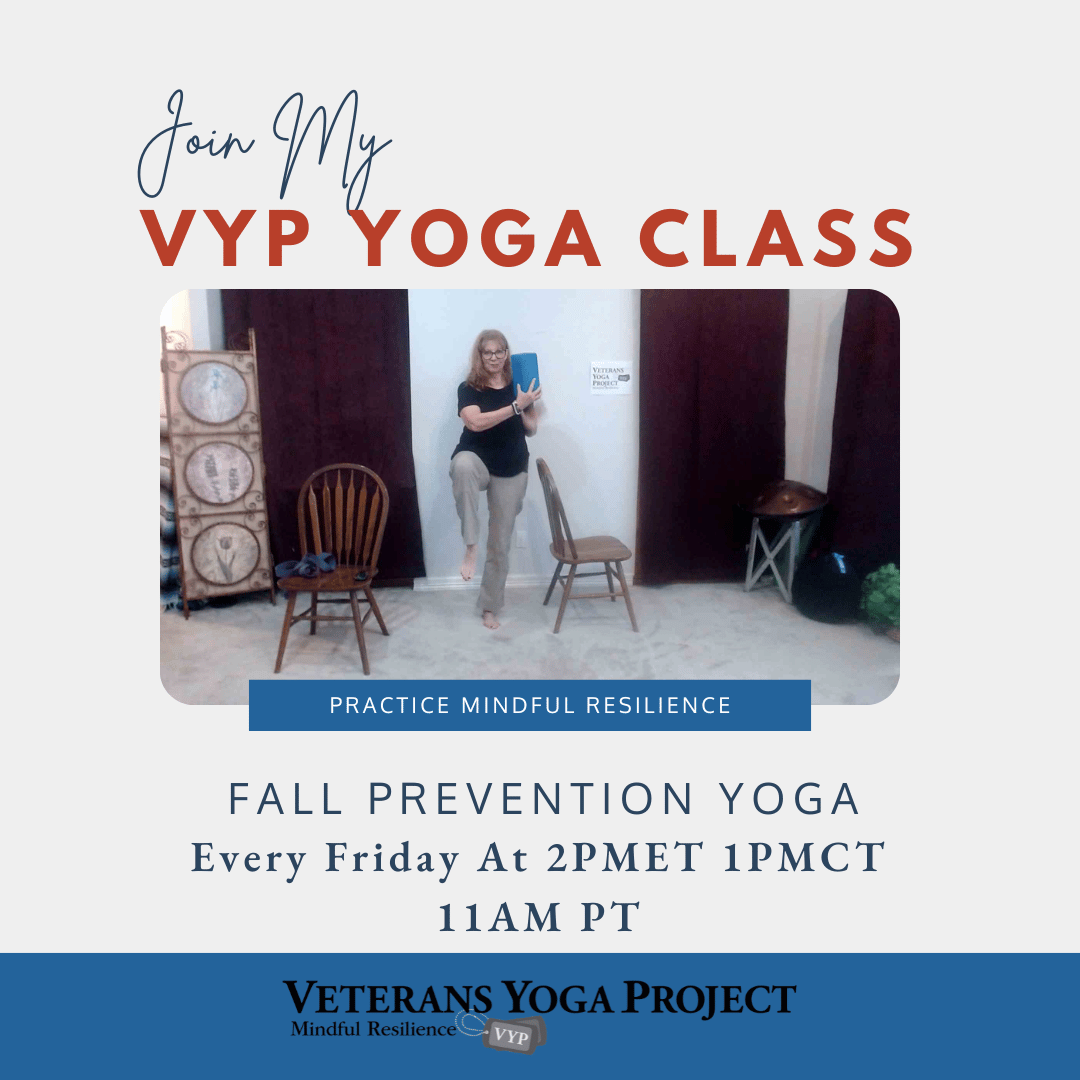
Fall Prevention Yoga Class using Two Chairs, Yoga Strap and Blocks for Improving Strength and Balance
Fall Prevention Yoga Class. Using Two Chairs, Yoga Strap and Block for Improving Strength and Balance

✅ Fridays — Chair Yoga for Fall Prevention

Join me every Friday at 1:00 PM CST / 11:00 AM PST for this energizing 60-minute session designed to improve balance, body awareness, and strength in a safe and supportive way.

Key Features:

  • Chair-supported balance exercises
  • Strength-building movements to reduce fall risk
  • No floor work required—great for people with limited mobility
  • Mindful breathing and body awareness to calm the nervous system

What You’ll Need:

  • Two chairs (one for movement, one for support)
  • Strap, yoga block
  • Optional: TheraBand, blanket, wall

💬 Side Note: Recent Student Reviews

Here’s what students are saying about these life-changing classes:

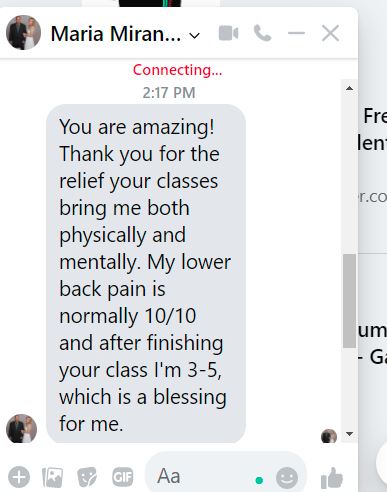
“I was experiencing level 6 pain in my hip and leg… After Gail’s class, my pain dropped to level 1. So grateful!”
JA, July 25, 2025 – Fall Prevention Chair Yoga

“Gail PB is amazing! I’ve had two knee replacements and still get a great workout.”
RM, July 24, 2025 – Gentle Yoga for Back Care

“Fantastic teacher! The practices make me feel better after class. The 3-step is really helpful—thanks Gail!”
LC, July 12, 2025 – Fall Prevention

“Gail’s Chair Tai Chi is wonderful—good for both body and mind. Would love to see even more of these classes!”
NW, July 16, 2025 – Chair Tai Chi

“I love Gail’s classes. They challenge me to get stronger and improve my balance. I’m thankful these are free.”
DA, multiple reviews from June–July 2025

“Gail’s knowledge is deep, and she presents with humor and warmth. Her Chair Yoga is one of my weekly must-do’s!”
DL, July 2, 2025 – Chair Tai Chi


🧘 Why These Classes Matter

  • Free for Veterans: Sponsored through the Veterans Yoga Project & VA partnership
  • Accessible and inclusive: No need to get on the floor
  • Safe and effective: Gentle movements adapted to your body’s needs
  • Whole Health support: Stress relief, pain reduction, emotional balance

📋 Weekly Snapshot

DayClassDurationFocus Area
Wednesday (alternating)Chair Tai Chi45 minMind-body connection, mobility
Wednesday (alternating)Gentle Yoga for Back Care60 minBack pain relief, strength & stretch
FridayChair Yoga for Fall Prevention60 minBalance, fall risk reduction

📝 How to Join

  1. Visit VeteransYogaProject.org
  2. Register for a free account on the WellnessLiving platform
  3. Reserve your spot for the class—and let’s move, breathe, and heal together

Let’s make mindful movement a part of your weekly wellness!
Reach out anytime if you have questions or need help getting started.


Meditative Photography

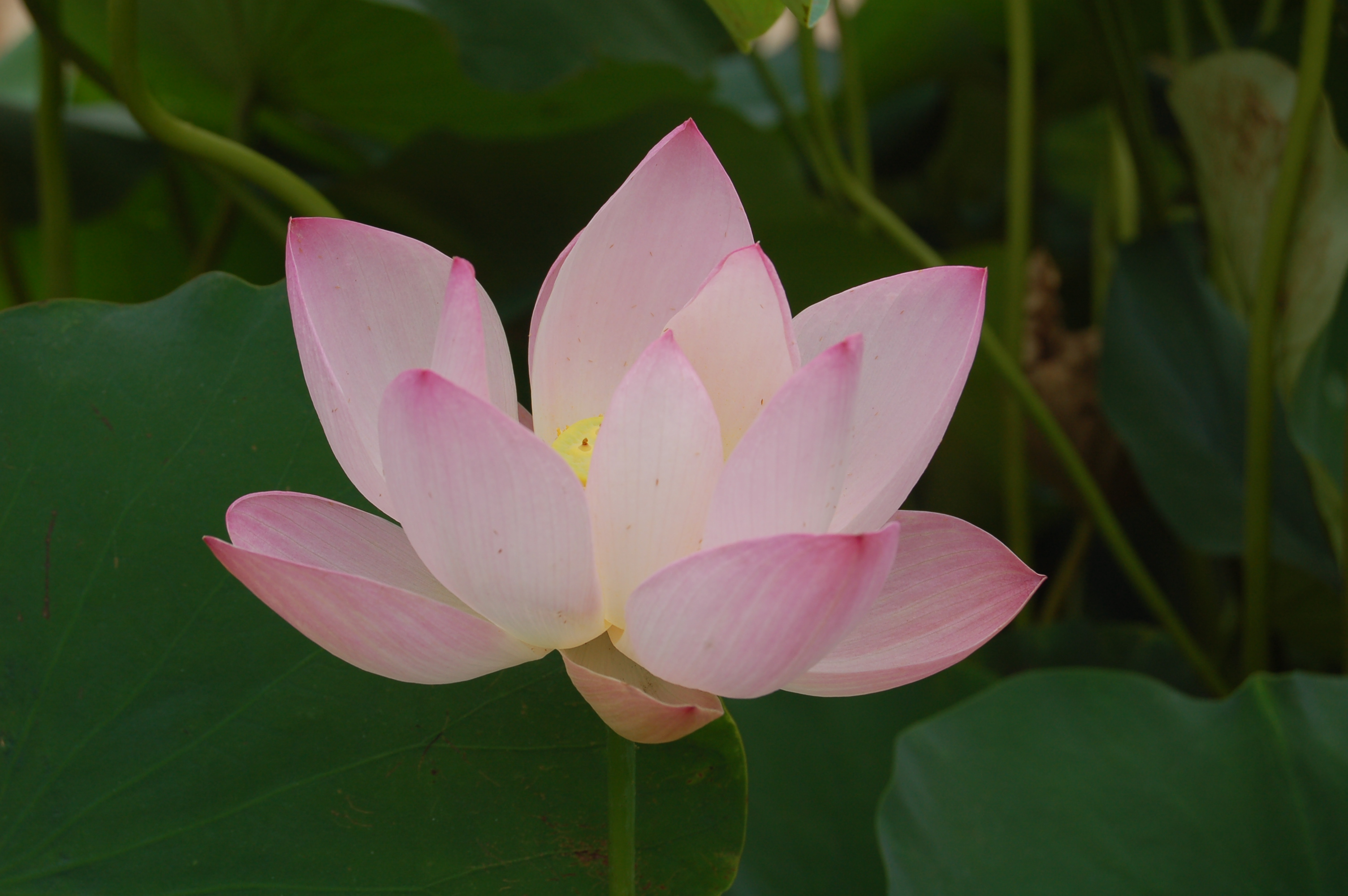
Enjoy this set of photographs that I took at the recent Pt Arthur Lotus Festival.

#lotusfestival #ptarthur #meditation #justbreathe
Meditation photography by Gail Pickens-Barger
Meditation Photography by Gail Pickens-Barger

Meditation May I be Happy

DIY Zafu Meditation Pillows | Meditation DIY Pillows

#zafu #zazen #seatedmeditation

Supporting Our Veterans Through Movement: My 2025 Fundraiser for Veterans Gratitude Week

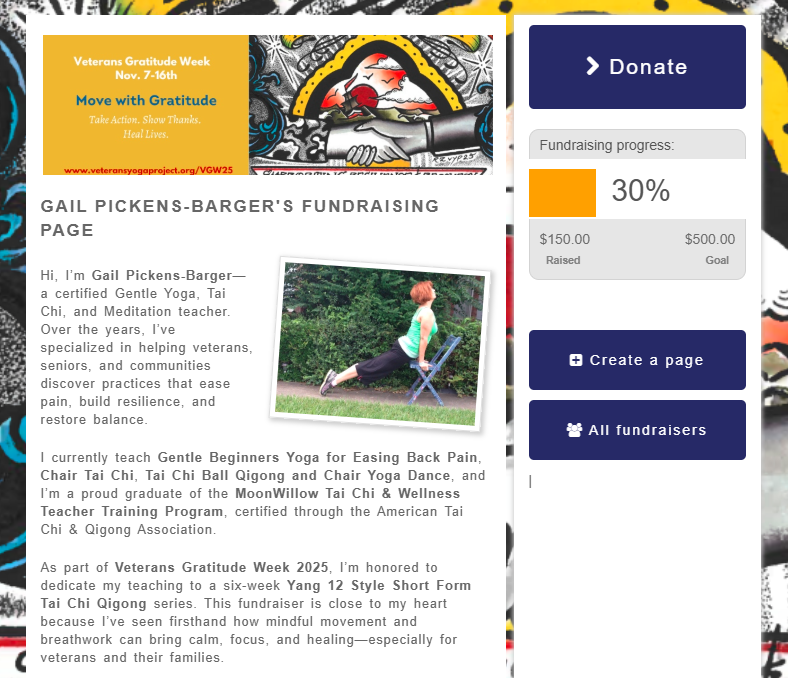
I’m excited to share that I’ve officially set up my fundraising page for Veterans Gratitude Week 2025 — and I’d love your support!

Each year, Veterans Yoga Project hosts this special week-long event, bringing together movement teachers from around the world to offer donation-based classes in support of veterans, active duty service members, and their families. It’s the organization’s largest fundraiser of the year, and it’s always an honor to be a part of it.

This year, I’ll be teaching two unique class offerings leading up to and during Veterans Gratitude Week:

🌀 Beginner Yang 12 Short Form Tai Chi – 6-Week Series – Online Class

If you’ve ever wanted to try Tai Chi, this is a great place to start!
This beginner-friendly series introduces you to the fundamentals of the Yang 12 Short Form. It’s gentle, flowing, and perfect for building balance, strength, and mindfulness — no experience needed.

🪑 Seated Chair Tai Chi BALL Qigong – Online Class

This fun and accessible class can be done right from your chair!
We’ll use a small, soft ball (or even a stuffed toy or sports ball) to enhance the practice. Great for all mobility levels, and especially helpful for those looking for a gentle way to connect breath and movement.

These classes are offered by donation, and 100% of the proceeds go directly to the Veterans Yoga Project to support their mission of empowering veterans through mindful resilience-building practices.

How You Can Help:

Join a class
Make a donation
Share the fundraiser with your community

Here’s the link to my official fundraising page:
👉 Gail Pickens-Barger – Veterans Gratitude Week Fundraiser 2025

Whether you join me on the mat (or chair!) or donate to the cause, your support means so much.

Let’s move with purpose, honor our veterans, and give back through gratitude. 💙🇺🇸


#VeteransGratitudeWeek2025 #VeteransYogaProject #TaiChi #ChairTaiChi #Qigong #SupportVeterans #GratitudeInAction #MindfulMovement #Fundraiser

Gail Pickens-Barger Veterans Gratitude Week Fundraiser 2025

🍂 New Fall Beginners Tai Chi Series – 6 Weeks to Balance & Calm

Six Week Series – Beginners Tai Chi with Gail PB

Beginners Six Week Series - Tai Chi with Gail PB

🍂 New Fall Beginners Tai Chi Series – 6 Weeks to Balance & Calm

As the seasons shift and we move into fall, it’s the perfect time to ground ourselves, slow down, and discover the gentle power of Tai Chi. I’m excited to announce a brand-new 6-Week Beginners Tai Chi Series, designed especially for those who are curious about Tai Chi or just starting out.

✨ What to Expect

This series will introduce you to the foundations of Yang Style Tai Chi, including:

  • Gentle, flowing movements to improve balance and coordination
  • Breathing practices to release stress and promote calm
  • Simple routines that build strength and flexibility without strain
  • A welcoming, supportive space for beginners of all ages

📅 Series Details

  • Length: 6 weeks
  • Format: Step-by-step instruction, building each week
  • Perfect for: Beginners, seniors, veterans, and anyone looking for mindful movement this fall

💡 Why Try Tai Chi?

Tai Chi is often called “meditation in motion.” With regular practice, many people notice:

  • Better balance and stability
  • Reduced stiffness and joint discomfort
  • Improved energy flow
  • A greater sense of inner peace

🍁 Join Us This Fall

Take this season as an opportunity to begin something new for your health and wellbeing. By the end of the 6 weeks, you’ll feel more confident with the movements and have simple practices you can use every day.

➡️ Registration is now open! [ Email: Yogawithgaileee@gmail.com ]

Spaces are limited, so reserve your spot soon. I can’t wait to share this beautiful practice with you!

🪑 Find Your Flow: The Gentle Power of Chair Tai Chi with Gail P-B

🪑 Find Your Flow: The Gentle Power of Chair Tai Chi with Gail P-B

In today’s busy world, wellness doesn’t have to be intense to be effective. With Chair Tai Chi with Gail P-B, you’re invited into a gentle, healing practice that meets you right where you are, seated, supported, and fully present.

Whether you’re easing back into movement, managing pain, or simply seeking calm, Chair Tai Chi offers a graceful way to reconnect with your body, breath, and inner balance.

🌿 What is Chair Tai Chi?

Chair Tai Chi brings the calming, flowing movements of traditional Tai Chi into a fully seated format. It’s ideal for anyone who wants the benefits of mindful movement without the need to stand or balance.

Perfect for:

  • Seniors
  • Veterans
  • People with limited mobility, balance challenges, or chronic pain
  • Beginners seeking a supportive and accessible practice

💚 Benefits You Can Feel

Chair Tai Chi gently supports your wellness journey:

  • Boosts circulation and flexibility
  • Improves posture and joint mobility
  • Reduces stress and anxiety through breathwork
  • Builds core stability to support fall prevention
  • Promotes a sense of calm, clarity, and inner peace

🎥 Practice with Me: Chair Tai Chi with Gail P-B

🌟
In this session, I’ll guide you through simple, flowing movements designed to help release tension, improve balance, and support your well-being—no standing required.

All you need is a comfortable, sturdy chair and a few moments to reconnect with your breath and body.

🌸 A Wellness Practice You Can Stick With

I believe movement should feel empowering, joyful, and accessible. Chair Tai Chi offers that and more, bringing relaxation, strength, and self-awareness into your daily life without strain.

Whether you’re just beginning or returning to movement after time away, this practice is here for you.


🧘‍♀️ Join me for Chair Tai Chi in person or online!
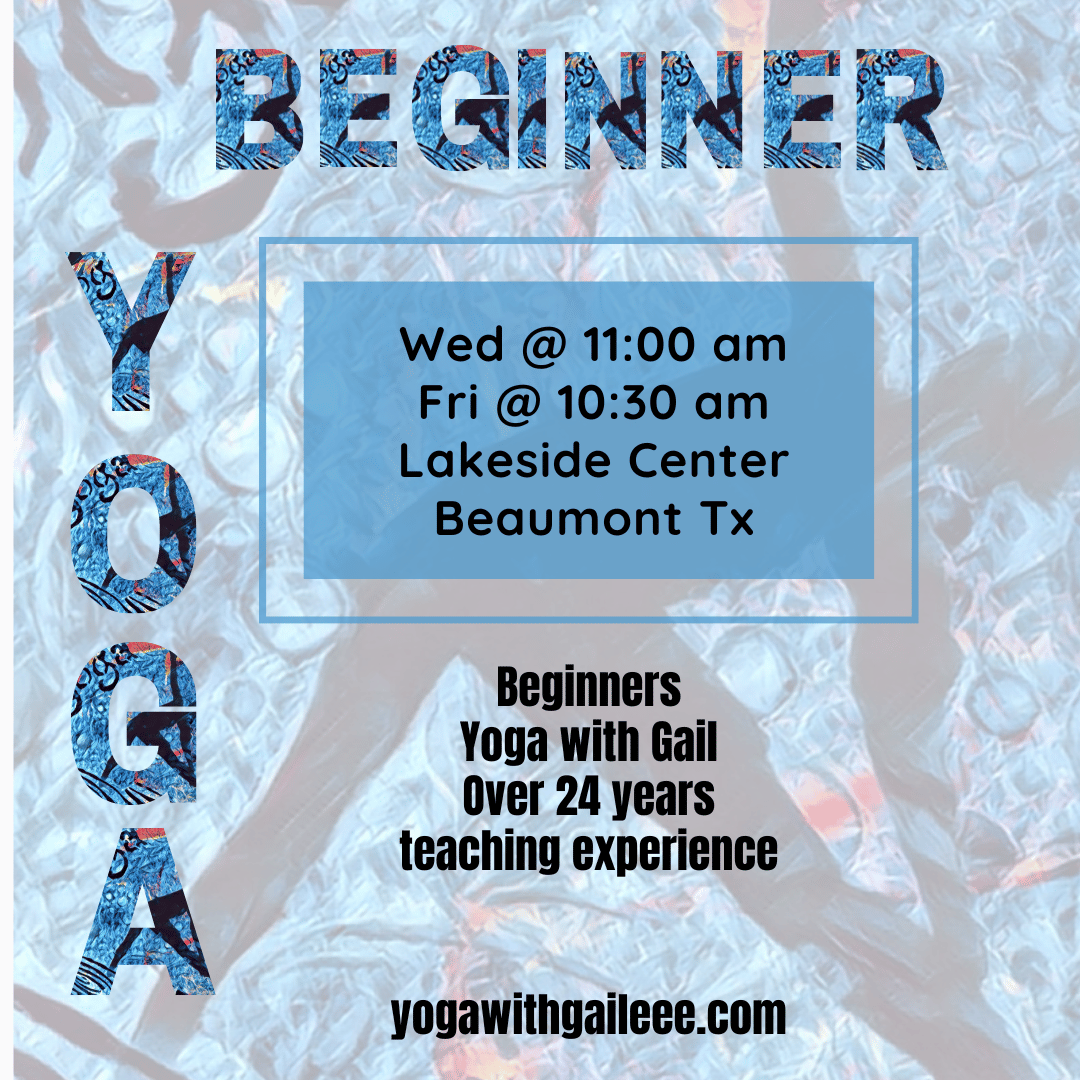
I teach this calming and accessible class in person every Wednesday at 11:00 AM Central Time at the Lakeside Center in Beaumont, Texas. Come early for your first time to register at the front desk.

Prefer online practice? I also offer Chair Tai Chi every other Wednesday through Veterans Yoga Project’s Wellness Living platform.
👉 https://veteransyogaproject.org/vyp-classes

Come move with me and discover how Chair Tai Chi can gently uplift your day—one breath, one movement at a time.

Stay tuned for more videos and sessions designed especially for you.

Upgrading My Computer to Windows 11 Using FlyBy11 + Post-Upgrade AV Testing

🖥️ Upgrading My Computer to Windows 11 Using FlyBy11 + Post-Upgrade AV Testing

After years of running smoothly on Windows 10, I decided it was time to upgrade to Windows 11—even though my PC wasn’t on Microsoft’s supported hardware list. Thanks to the FlyBy11 method, I was able to complete the upgrade without a hitch. Here’s a quick overview of my upgrade experience and how I verified my audio and video systems afterward.


Step-by-Step: How I Upgraded Using FlyBy11

I followed the instructions in a video guide that walked through upgrading unsupported PCs to Windows 11 using the FlyBy11 script. This method bypasses Microsoft’s hardware checks in a safe and controlled way.

Here’s a quick summary of the process:

  1. Backed up important files.
    Always a must before any major upgrade.
  2. Downloaded the FlyBy11 script from GitHub.
    (It automates bypassing the TPM, Secure Boot, and CPU checks.)
  3. Ran the script and initiated the upgrade.
    I used a Windows 11 ISO downloaded directly from Microsoft.
  4. The install process was smooth—no hiccups or compatibility warnings.
  5. After reboot, I had a fresh Windows 11 desktop with all my apps and settings intact.

🔊🎥 Post-Upgrade Testing: Audio & Video

After the upgrade, I made it a priority to test everything related to my workflow—especially audio and video, since I use my computer to teach yoga and chair tai chi both online and in person.

Here’s what I tested and verified:

🎤 Audio Tests

  • ✅ Microphone detection in Zoom, OBS, and Audacity
  • ✅ No latency issues or audio dropouts
  • ✅ Speakers and Bluetooth earbuds connected without trouble

🎥 Video Tests

  • ✅ Webcam recognized in Zoom, OBS, and Camera app
  • ✅ Background blur and virtual backgrounds worked smoothly
  • ✅ OBS Studio scene switching and virtual cam all functioned as before

All audio/video settings and customizations I had on Windows 10 carried over without needing reconfiguration. I did though have an HP printer notification pop up during a recording LIVE on YouTube, so I’ll need to check into suppressing notifications.

Here’s one of the “Live” videos I did to test both the audio and video after the upgrade!


🧘‍♀️ Why This Matters for My Work

I teach Chair Yoga, Tai Chi, and Guided Meditation virtually, so reliable audio/video is crucial. The upgrade allowed me to enjoy the sleeker interface of Windows 11 and improved multi-window features, without sacrificing stability in my teaching platforms.

If you’re a fellow wellness educator, you’ll appreciate the importance of:

  • Smooth streaming (no lag)
  • Clear voice capture for cues and instruction
  • Visual clarity for demonstrations

So far, Windows 11 is delivering.


📌 Final Thoughts

If you’re still running Windows 10 on an older machine and wondering whether an upgrade is possible, FlyBy11 is a viable solution—just be sure to back up and follow each step carefully.

💡Pro Tip: After upgrading, take the time to recheck every tool you rely on—especially audio and video apps—to ensure everything transitioned properly.

Let me know in the comments if you’ve tried this method, or if you’re considering upgrading and have questions!


Chair Yoga for Fall Prevention: A Comprehensive Guide


Chair Yoga for Fall Prevention: A Comprehensive Guide

🌿 Introduction to Chair Yoga

Chair yoga is a gentle, modified form of traditional yoga performed while seated or using a chair for support—making it accessible for individuals with limited mobility, balance concerns, or post‑injury limitations. It emphasizes safety, encouraging practitioners to stay “between the easy and the ouch” by honoring their body’s limits. Through mindful movement, chair yoga improves flexibility, strength, balance, and confidence in daily activity. As AP News reports, it “offers significant benefits such as improved flexibility, strength, balance, and emotional well‑being” and is particularly valuable for fall prevention among older adults (apnews.com).


Why Fall Prevention Matters

Falls are a leading cause of injury among older adults, often resulting in fractures, hospitalizations, and declines in independence (pmc.ncbi.nlm.nih.gov). Chair yoga directly addresses this risk by combining gentle strength and balance work in a safe, supportive setting.


1. Warm‑Up Foundation

A vital warm‑up primes the body and mind for effective practice:

  • Gentle joint mobilization: Shake arms, bounce knees, roll shoulders and wrists.
  • Breath awareness: Anchor the session with mindful inhaling and exhaling.
  • Circulation boost: Circulate blood flow to stiff areas, setting the tone for safety and effectiveness.

2. Breathing Techniques

Conscious breathing deepens the practice and supports relaxation:

  • Deep belly breathing: Inhale to expand the diaphragm; exhale to engage the core.
  • Back-of-throat listening: Amplifies breath awareness and focus.
  • Synchronize breath and movement: Link inhales and exhales to spinal elongation and flexion—for example, during seated Cat‑Cow.

3. Strengthening & Balance Exercises

Adaptable and functional, these exercises support day‑to‑day movement and reduce fall risk:

  • Arm swings & shoulder lubrications: Strengthen upper body and shoulder joints.
  • Core engagement: Maintain upright posture during breathing and movement.
  • Step‑touch drills & foot patterns: Enhance lower‑body coordination and strength.

Research confirms chair yoga builds upper‑ and lower‑body strength, improving functional mobility (ncbi.nlm.nih.gov).


4. Lymphatic Health & Detoxification

Chair yoga supports circulation of lymph—crucial for immune health:

  • Understanding lymphatic system: A pump‑less system dependent on body movement.
  • “Big six” drainage techniques: Gentle strokes from jawline, neck, and collarbone towards lymph nodes can reduce stagnation and boost recovery (glamour.com).
  • Daily flow practices: Light tapping or shaking of limbs promotes detoxification and vitality.

5. Spinal Mobility & Alignment

Strong spine posture and mobility are central to balance and fall prevention:

  • Seated Cat‑Cow: Alternating spinal arch and round to maintain flexibility.
  • Pelvic Tilts: Enhance core strength and support the lower back.
  • Unsupported Twists & Lateral Flexion: Gentle side‑bends and rotations to improve spinal health.

Breath coordination—for example, inhaling on extension and exhaling on flexion—supports form and reduces tension.


6. Mindfulness & Present Moment Awareness

Building mind‑body connection is essential:

  • Mindful movement: Observe sensations, posture, and alignment without judgment.
  • Breath‑focused drills: Techniques like “elongated exhale” or pranayama encourage calm and resilience.
  • Simple rituals: Gentle clapping to stimulate energy, gratitude reflections to foster positivity.

7. Sample Chair Yoga Sequence

  1. Warm‑up (5 min): Arm shakes, shoulder rolls, breath work.
  2. Breathing & spinal flow (5 min): Deep belly breathing, Cat‑Cow with breath.
  3. Strength & balance (10 min): Heel‑toe lifts, step‑touch drills, seated leg swings.
  4. Lymphatic flow (5 min): Gentle tapping across neck and collarbones, light leg shakes.
  5. Spinal mobility (5 min): Pelvic tilts, seated twists, side‑bends.
  6. Mindful cool‑down (5 min): Elongated exhales, gratitude focus, gentle neck rolls.

8. Homework & Daily Practice

Consistency builds confidence and resilience:

  • Seated Clam Shells with Yoga Strap or Stretchy Band: 10 min/day to strengthen hip musculature complex. This is a variation of the side lying mat pilates movement, where, Clamshells—where you lie on your side and open your knee like a shell, exercises targeting hip stabilizers with resistance bands, weights. But in this circumstance we use either therabands or yoga straps, seated on the chiar for this strength builder.
  • Sit‑to‑stand reps: Aim for 10 controlled transitions to build leg/behind strength.
  • Walking drills: Use chair support to enhance balance and coordination.
  • Three‑point step drills: Develop agility and weight‑shift control, better balance and build strength.

9. Support from Research

  • A 12‑week study in psychiatric inpatients showed increases in strength, flexibility, and reduced fear of falling (yogianatomy.com, pubmed.ncbi.nlm.nih.gov).
  • A pilot trial in elderly at high fall risk recorded improved sit‑to‑stand scores and reduced fall anxiety, with no adverse events (pubmed.ncbi.nlm.nih.gov).
  • Meta‑analyses report significant gains in upper‑body strength and lower‑body endurance following chair‑based programs (mdpi.com).

✨ Final Thoughts & Encouragement

Chair yoga offers a powerful, accessible pathway to enhanced mobility, balance, and well‑being. While progress takes time, even short daily practice can produce confidence and reduce fall risk. Embrace the chair as your ally and move with kindness and curiosity. With consistent dedication, you’ll discover newfound stability, strength, and peace.


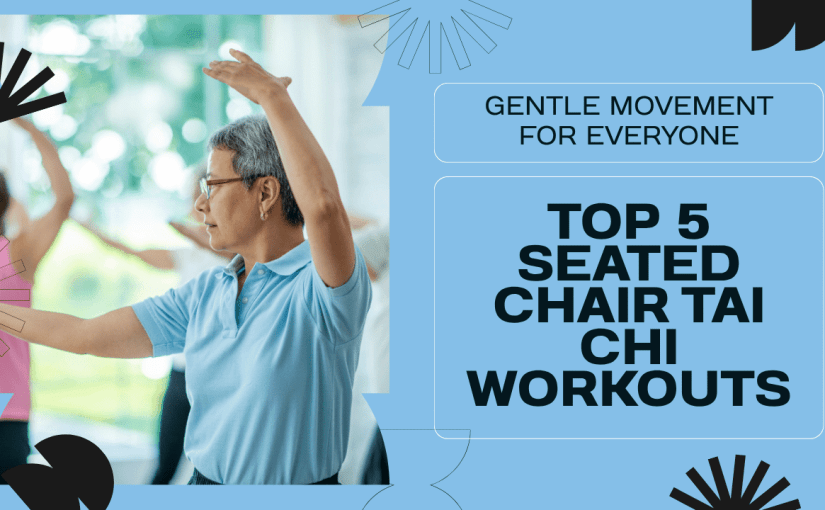
Top Five Seated Chair Tai Chi Practices with teacher Gail Pickens-Barger

Top Five Seated Chair Tai Chi Practices with teacher Gail Pickens-Barger

🪑 Ease Aches & Pains Through Chair Tai Chi – 44-Minute Seated Class

In this 44-minute seated Tai Chi session, instructor Gail Pickens-Barger leads participants through a series of gentle movements designed to alleviate common aches and pains. The routine focuses on slow, deliberate motions that promote joint mobility, reduce stiffness, and enhance overall well-being.

🌿 Key Highlights:
Gentle Movements: Emphasis on slow, controlled motions to enhance joint mobility and reduce stiffness.

Breathing Techniques: Incorporates deep breathing exercises to promote relaxation and oxygenate the body.

Seated Practice: Designed to be performed while seated, making it accessible for individuals with limited mobility.

Pain Relief: Targets common areas of discomfort, such as the back, shoulders, and hips, offering relief through mindful movement.

This session is ideal for seniors or anyone seeking a gentle introduction to Tai Chi, offering a supportive environment to improve physical well-being and reduce discomfort.

🪑 Ease Tension, Stress, and Pain Through Simple Chair Tai Chi – New Year’s Day Practice (47 Minutes)

Start the year with a calming and rejuvenating 47-minute seated Tai Chi session led by Gail Pickens-Barger. This gentle practice is designed to alleviate tension, reduce stress, and ease discomfort, making it ideal for seniors or anyone seeking a mindful movement routine.

🌿 Key Highlights:
Gentle Movements: Emphasis on slow, deliberate motions to promote relaxation and flexibility.

Breathing Techniques: Incorporates deep breathing exercises to enhance oxygen flow and calm the mind.

Seated Practice: Performed while seated, ensuring accessibility for individuals with limited mobility.

Mindfulness: Encourages present-moment awareness, fostering a sense of inner peace and well-being.

This session is a perfect way to begin the year with a focus on self-care and holistic health. Whether you’re new to Tai Chi or looking to deepen your practice, this routine offers a gentle introduction to the benefits of mindful movement.

🖐️ Chair Tai Chi Exercises for Hands and Fingers to Ease Aches – 6-Minute Seated Class

In this brief yet effective session, instructor Gail Pickens-Barger leads a 6-minute seated Tai Chi routine specifically designed to alleviate hand and finger discomfort. The exercises focus on gentle movements that promote joint mobility, reduce stiffness, and enhance overall hand function.

🌿 Key Highlights:
Gentle Finger Movements: Incorporates slow, deliberate motions to improve dexterity and reduce tension.

Joint Mobilization: Targets key areas such as the wrists and fingers to enhance flexibility.

Breathing Techniques: Emphasizes deep breathing to promote relaxation and increase oxygen flow to the muscles.

Seated Practice: Designed to be performed while seated, making it accessible for individuals with limited mobility.

This session is ideal for seniors or anyone experiencing hand and finger discomfort, offering a quick and effective way to improve hand health and reduce pain.

🪑 Gentle Chair Tai Chi: Boost Mobility & Relieve Aches & Pains – 47-Minute Seated Class

In this 47-minute seated Tai Chi session, instructor Gail Pickens-Barger guides participants through a series of gentle movements designed to enhance mobility and alleviate common aches and pains. The routine emphasizes slow, deliberate motions that promote joint flexibility, improve circulation, and reduce muscle tension.

🌿 Key Highlights:
Gentle Movements: Focuses on slow, controlled motions to enhance joint mobility and reduce stiffness.

Breathing Techniques: Incorporates deep breathing exercises to promote relaxation and oxygenate the body.

Seated Practice: Designed to be performed while seated, making it accessible for individuals with limited mobility.

Pain Relief: Targets common areas of discomfort, such as the back, shoulders, and hips, offering relief through mindful movement.

This session is ideal for seniors or anyone seeking a gentle introduction to Tai Chi, offering a supportive environment to improve physical well-being and reduce discomfort.

🪑 Seated Chair Tai Chi & Qigong for Beginners: Gentle Healing Flow with Gail PB
Duration: 50 minutes

In this gentle and accessible session, Gail Pickens-Barger leads a seated Tai Chi and Qigong practice designed specifically for beginners. The routine focuses on slow, mindful movements that promote relaxation, improve flexibility, and enhance overall well-being.

Plus to see the full Seated Chair Tai Chi Playlist, I have the following.

Which one is your favorite?

May the Force, er, um, May the Fall Prevention Chair Yoga Classes, keep you upright!

May the Force, er, um… May the Fall Prevention Chair Yoga Classes, keep you upright!

The month of May had FIVE Fridays on the calendar, and as such there was a lot of Chair Yoga for Fall Preventions classes up on Veterans Yoga Project online studio.

I record the classes (just on me), and provide these for my folks to do more than once a week, or they register and get a follow up email link with the video. I have about 6-8 students who regularly register, but can’t come to the specific time frame, but they love the videos.

I’m also learning to do YouTube SEO, Search Engine Optimization, to get these “said” videos a bit of traction on the #2 Search Engine out there… YouTube!

Here is May’s Chair Yoga Classes. I still have a bit to learn (well a LOT) on YouTube SEO, to bear with me folks. Any insider pointers would be nice to know too!

MAKE NOTE. Two chairs, yoga block and strap make this a great class. A wall and one chair work too! Some folks use a theraband, but I like the cloth straps for better muscle building. P.S. There is an opportunity to do homework too!


May 1, 2025
Chair Yoga Fall Prevention. This video contains hand and finger mobility, plus hand tapping in addition to our traditional working toward homework assignments
https://youtu.be/7_S_fF37gGg


May 9, 2025
Chair Yoga Fall Prevention. Discover simple, effective yoga movements designed to improve balance, build strength, and prevent falls — especially for seniors and older adults. In this short class, we’ll guide you through essential poses and gentle stretches proven to enhance stability and confidence in everyday movement.
https://youtu.be/h56D_Ior52k


May 16, 2025
Chair Yoga Fall Prevention. This class has a longer rotation of conciousness or otherwise known as a body scan, for lessening anxiety, reducing the monkey mind, easing pain in the body sequence.


May 23, 2025
Chair Yoga Fall Prevention. This class features a Cognitive Behavioral Therapy Technique for lessening pain in targeted areas. See the table to contents for specific exercises. This class also has the targetted three homework assignments.
https://youtu.be/dpKWjM4v26E


May 30, 2025
Chair Yoga Fall Prevention. In this class there is an additional joint freeing sequence to allow you to work towards a deeper squat.
https://youtu.be/MPla5bqFZgI

Yoga for Sciatica: Poses for Piriformis Syndrome vs. True Sciatica

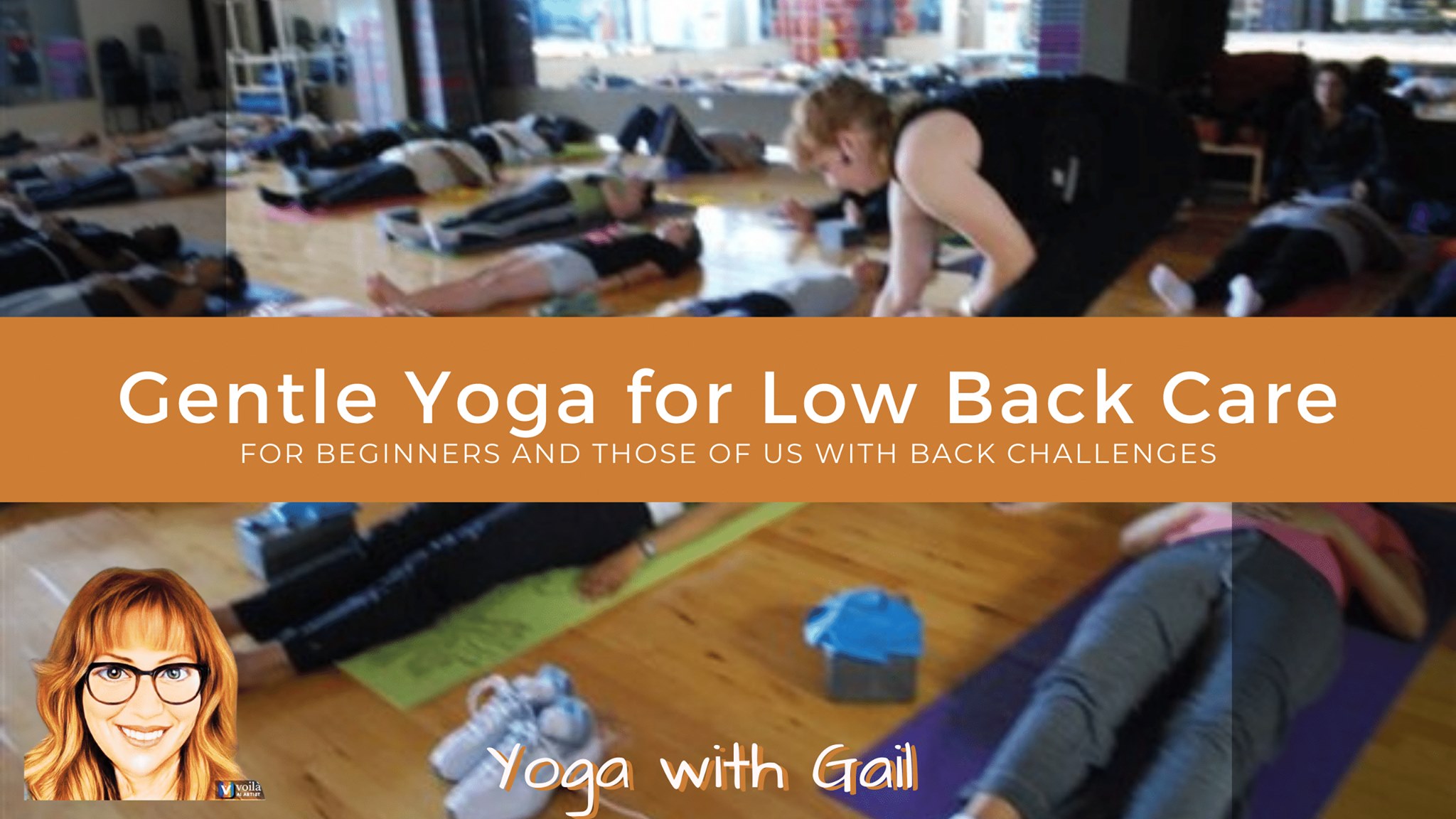
Gentle Yoga for Low Back Care with Gail Pickens-Barger

Yoga for Sciatica: Poses for Piriformis Syndrome vs. True Sciatica

Sciatica pain can be confusing, frustrating, and—at times—debilitating. But did you know that not all sciatica is the same? There are two primary types: sciatic nerve entrapment (often caused by Piriformis Syndrome) and true sciatica (caused by lumbar nerve root compression). Understanding which one you’re dealing with is essential to practicing yoga safely and effectively.

In this post, we’ll break down the difference between the two types of sciatica and compare yoga poses that are safe and supportive for each. Plus, you’ll get a clear list of poses to avoid, modify, or embrace depending on your condition.


🔍 Understanding the Two Types of Sciatica

1. Sciatic Nerve Entrapment (Piriformis Syndrome)

This type of sciatica occurs when the piriformis muscle (located deep in the buttocks) compresses the sciatic nerve. This can happen when the muscle becomes tight, inflamed, or spasms. It’s especially common in people with postural imbalances, prolonged sitting, or gluteal weakness.

2. True Sciatica (Lumbar Nerve Root Compression)

In this case, the sciatic nerve is compressed at the nerve root as it exits the lower spine. Common causes include herniated discs, spinal stenosis, or degenerative disc disease. This version often includes nerve symptoms that travel down the leg and into the foot.


🧘‍♀️ Shared Yoga Goals for Both Types of Sciatica

Despite their differences, both forms of sciatica benefit from:

  • Gentle movement
  • Supportive hip and spine alignment
  • Avoiding overstretching of the sciatic nerve
  • Reducing muscular compression and spinal pressure

✅ Yoga Poses Safe for Both Conditions

These foundational poses are typically safe and beneficial for most people with sciatica:

  • Knee to Chest Pose
  • Supta Baddha Konasana (Reclined Bound Angle / Band Aid Pose)
  • Rolling Bridge Pose
  • Flowy Cat-Cow
  • Supported Low Cobra or Half Locust

These poses provide spinal mobility, promote relaxation, and gently stretch and activate muscles without stressing the nerve.


🧘 Yoga for Piriformis Syndrome (Nerve Entrapment)

These poses focus on relieving tension in the piriformis and improving gluteal strength and hip mobility:

  • Reclined Pigeon
  • Reclined Lateral Pigeon
  • Reclined Cow Face Pose
  • Clam Shell Exercise (great for strengthening outer hips)
  • Strap-Assisted Piriformis Twist
  • Lateral Sunbird Stretch
  • Twist with External Hip Rotation
  • Viminasana with Rotation
  • Goddess Pose (wide stance, modified as needed)

🌿 Yoga for True Sciatica (Lumbar Nerve Compression)

These poses emphasize spinal decompression, gentle backbends, and safe movement that doesn’t aggravate the nerve root:

  • Knees to Chest with Circular Movements
  • Reverse Pigeon (safer version of traditional pigeon)
  • Gentle Supine Twist
  • Crocodile Breathing (laying on stomach with blanket under pelvis)
  • Salabasana (Low Locust)
  • Uttanasana (Forward Fold with bent knees)
  • Mountain Pose (with or without arm engagement)
  • Wide-Legged Down Dog (bent knees recommended)

⚠️ Poses to Modify or Avoid

Some poses are helpful in one condition but potentially harmful in the other. Here’s a quick comparison:

PoseGood for Piriformis SyndromeGood for True Sciatica
Reclined Pigeon✅ Yes⚠️ Caution
Reclined Lateral Pigeon✅ Yes❌ Avoid
Clam Shell✅ Yes❌ Not necessary
External Hip Twists✅ Yes❌ Avoid
Forward Fold (Uttanasana)❌ Avoid⚠️ Use props and bend knees
Wide-Legged Down Dog❌ Avoid⚠️ Modify with bent knees

🧾 Final Thoughts

Yoga can be a powerful tool for managing sciatica—but only when it’s tailored to your body and your specific condition. Whether you’re dealing with piriformis-related nerve entrapment or spinal root compression, choosing the right poses can mean the difference between healing and aggravation.

If you’re unsure which type of sciatica you have, start with the shared safe poses and consult a healthcare provider or qualified yoga therapist.


💬 Share Your Experience

Have you practiced yoga for sciatica relief? What’s helped you the most? Share your story in the comments or ask a question—I’d love to support your healing journey.


💬 Join me online for Gentle yoga for back care on Veterans Yoga Project online studio, every other Wednesday at 1 PM Central Time. Class is free, grab a free account, book the class.

🧘 Full-Length Yoga for Fall Prevention – Improve Balance & Stability at Any Age

A Full Yoga Class to Help You Move with Confidence

Falls are a serious concern, especially as we age. This full-length guided yoga class is designed to help you feel more stable, confident, and in control of your movement.

In just one session, you’ll work on:

✅ Improving balance and core strength
✅ Enhancing posture and body awareness
✅ Building lower body strength and flexibility
✅ Gaining confidence with guided movement

🎥 Hit play and follow along now:
👉 Yoga for Fall Prevention – Improve Balance & Stability at Any Age

What Makes This Class Special

✅ Designed by an instructor who teaches Veterans
✅ Emphasis on strength, focus, and mindfulness
✅ Chair and wall-supported options throughout
✅ Grounded in practical, functional movement—not flashy poses


Who This Class Is For

  • Older adults wanting to reduce fall risk
  • Veterans seeking balance, strength, and calm
  • Beginners or those recovering from injury
  • Anyone who wants to feel safer moving through daily life

What You’ll Need

🪑 Two chairs or wall & one chair for support,
🧘 Yoga block, strap or a stretchy band
👚 Comfortable clothes
🕒 About 45 – 60 minutes of quiet time


Let’s Move Together

This class combines mindful movement, strength-building postures, and balance-focused exercises. If you’re looking for a safe, calming practice that meets you where you are—this is it.

💡 Veteran or caregiver? I’ve designed this with you in mind. I teach this same class in-person to Veterans and community members, friends and family, and I’d be honored to share it with you.


Ready to Begin?

👉 Click the video above and join me now.
Try practicing 2–3 times a week and notice how your balance and confidence improve.

Missed the Live Class? Join Anytime from Home

Not everyone can make it to class live—and that’s okay. I record every class I teach so that you can practice when it works for you. Whether you’re a busy caregiver, a Veteran managing your own healing journey, or simply prefer flexibility, this full-length yoga session is available on-demand, anytime.

Who This Class Is For

  • Veterans and civilians alike seeking stability
  • Adults 55+ wanting to prevent falls
  • Anyone recovering from injury or instability
  • Caregivers looking for safe exercises to share

Practice On Your Time

🕒 This class is available 24/7
🪑 Includes options with a chair or wall for support
👣 You can pause, rewind, or revisit any time
💻 Watch on your phone, tablet, or computer

You’re not just watching a video—you’re taking a class, on your time.

🧘‍♀️ Fall Prevention Yoga: Simple Moves to Improve Balance, Strength, and Confidence

🧘‍♀️ Fall Prevention Yoga: Simple Moves to Improve Balance, Strength, and Confidence

Worried about your balance or afraid of falling? You’re not alone—and the good news is, you can do something about it.

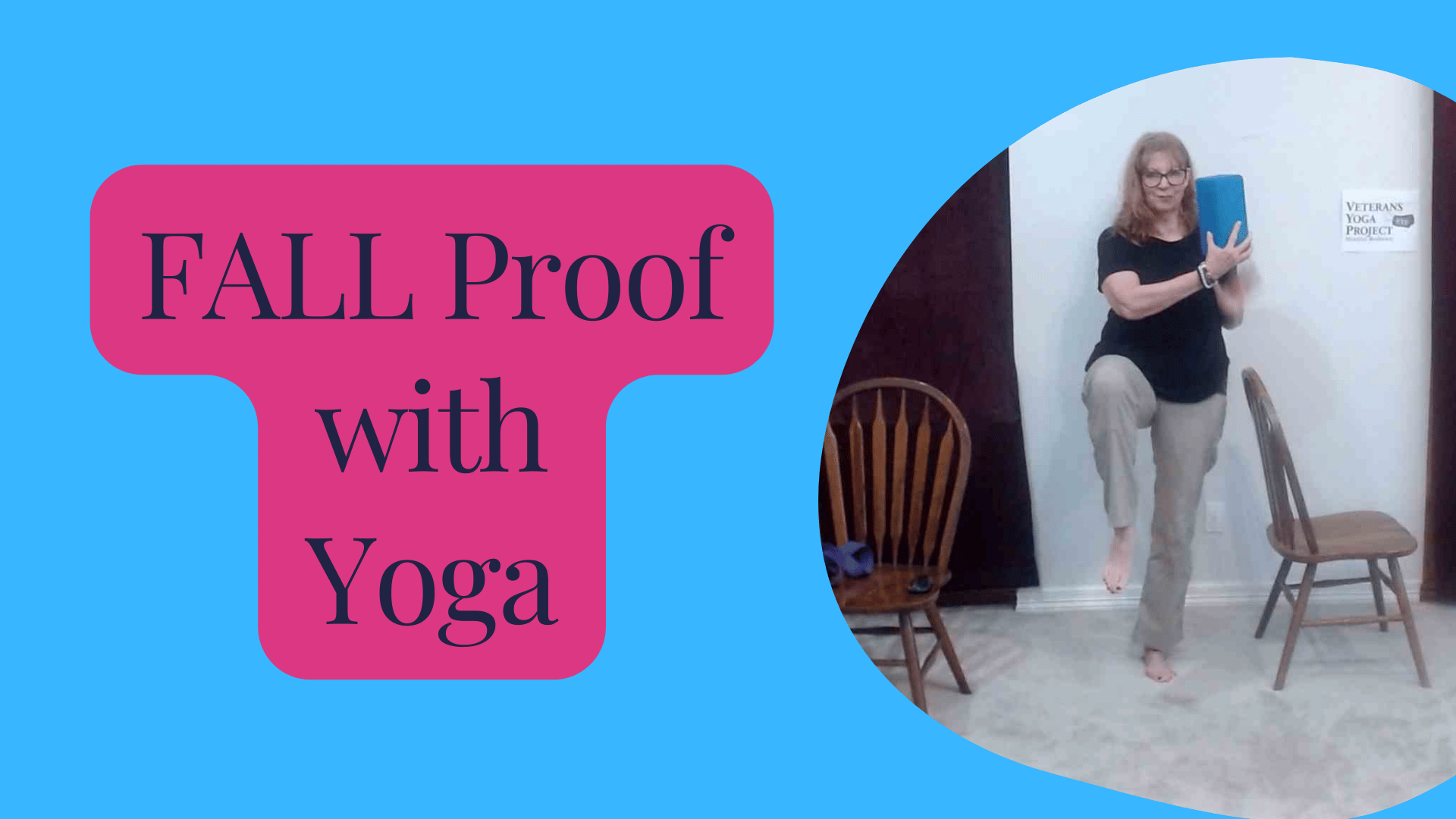
FALL  proof with Yoga

In this article, we’ll explore how yoga can help prevent falls, improve balance, and build strength—especially for seniors or anyone looking for a gentle, effective way to stay steady on their feet.


✅ Why Fall Prevention Matters

Falls are the leading cause of injury among older adults. But many of these falls are preventable with the right exercises. That’s where Fall Prevention Yoga comes in. It’s low-impact, easy on the joints, and incredibly effective at improving:

  • Balance
  • Core strength
  • Flexibility
  • Body awareness

🧘‍♀️ What Is Fall Prevention Yoga?

Fall prevention yoga is a targeted yoga routine designed to strengthen the muscles that keep you upright—like your core, glutes, and legs—while also improving coordination and mobility.

Unlike high-intensity workouts, this type of yoga is gentle, intentional, and beginner-friendly. No crazy poses, no stress—just movements that make you feel strong and supported.


💪 Benefits of Yoga for Balance and Fall Prevention

  1. Improved Stability: Yoga teaches you how to engage your core and stabilize your body in different positions.
  2. Increased Flexibility: Loosening tight muscles helps you move more freely and safely.
  3. Greater Confidence: The more balanced you feel, the more confident you’ll be doing daily activities.
  4. Stress Relief: Deep breathing and mindfulness help reduce anxiety and improve mental clarity.

▶️ Follow Along: Fall Prevention Yoga Video

Looking to get started? Check out my full Fall Prevention Yoga Routine on YouTube! It’s designed for seniors and beginners, and takes you through a step-by-step session to boost balance and strength.

👉 Watch it here:

Pro Tip: Repeat the routine 2–3 times per week for best results!


🏠 Minimal Equipment Needed

All you need is:

  • A yoga mat or soft surface
  • Two chairs for balance (optional)
  • A yoga strap
  • A yoga block
  • A little space to move

💬 Final Thoughts

Staying balanced and strong doesn’t require hours in the gym or fancy equipment. Just a few minutes a week of focused movement can help you feel more secure, mobile, and empowered in your body.

Take that first step—literally! 😊

👉 Don’t forget to subscribe to the YouTube channel for more senior-friendly workouts and wellness tips.

Fall Prevention Yoga for better balance

Fall prevention yoga movements for better balance

This format follows the old timey aerobic class workout. The warm up, in which we do a modified Seokmun Hoheup warmup movements. It really works all the places in the body, and warms up the major and minor joints in the body.

Then a traditional strength and stretch section. We use therabands, yoga straps, a chair and yoga block. If you don’t have the gear, minimally have access to a chair!

Lastly we do balance, stretches and more strength building, using two chairs or access to a wall and a chair. Ending with a guided rest & relaxation and gratitude practice.

Checkout my latest video playlist for this movement series.

Chair Tai Chi & Gentle Beginners Yoga for Back Care Classes – 2025

Chair Tai Chi & Gentle Beginners Yoga for Back Care Classes

February 2025. For Veterans Yoga Project Online Studio, Gail Pickens-Barger, Yoga Instructor/Chair Tai Chi Instructor. New schedule update.

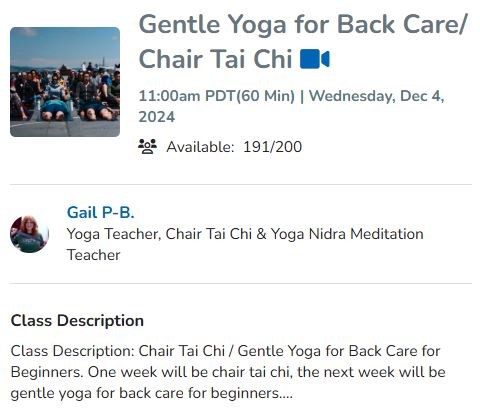
Wednesdays Gentle Yoga for Back Care/ Chair Tai Chi. 11:00am PST(60 min) | Wednesdays | 1:00pm CST(60 min)

Fridays Chair Yoga for Fall Prevention. 11:00 am PST (60 min) | Fridays | 1:00 pm CST (60 mins)

Gail Pickens-Barger

Yoga Teacher, Chair Tai Chi & Yoga Nidra Meditation Teacher

Class Description: Chair Tai Chi / Gentle Yoga for Back Care for Beginners. One week will be chair tai chi, the next week will be gentle yoga for back care for beginners.

Chair Tai Chi Class Description:
 
Chair Tai Chi is a 45 minute class, consisting of a blend of Yang Style Tai Chi forms (singled out for adaptability in a seated position), Shaolin muscle and sinew exercises, qigong (“chee-kung”) detoxing techniques, hand/finger/eye exercises, acupressure point stimulation, and guided rest & relaxation & gratitude practice.

Benefits: Chronic pain reduction, improved strength and flexibility, range of motion, posture, blood pressure, sleep, digestion, and immunity. Relieves stress, anxiety, and aids in overall well-being. Chair Tai Chi is a unique therapeutic modality being offered in the online Veterans Yoga Project studio.
 
*Special instructions for Chair Tai Chi:
Please have a sturdy chair available.

*******

Gentle Yoga for Back Care Beginners Class Description:

This 60 minute class is formatted for those of all ages and levels who experience low back pain, whether chronic or due to injury. The use of gear is encouraged to help support you through class which is presented every other week with our resident VYP expert, Gail Pickens-Barger. Class can be done on a yoga mat, or seated on a chair.

Special Instructions
Please have on hand:
* a strap
* a block
* access to a non-stick surface (a.k.a. yoga mat) or be seated on a chair

Optional items to have on hand are:
* a blanket/cover
* access to a wall or chair/table.  

You don’t have to bend like a pretzel to do yoga!

Example of Back Yoga for Beginners. Ease your back challenges with simple, effective movements.

Check out my latest “Live” video. I was testing the video quality and sound at a remote location. Sound is not as crisp as I would like, but is tolerable. Movement sequences for hands and fingers for easing pain and arthritis.

Stay Balanced with Chair Yoga for Fall Prevention

Stay Balanced with Chair Yoga for Fall Prevention. Online Studio class from Veterans Yoga Project on Fridays at 1 PM CST.

Stay Balanced with Chair Yoga

A weekly Chair Yoga class where we use two chairs, a block and a strap to help strengthen the leg/hip musculature. Work on our balance in this class too. A few Chair Tai Chi inspired movements are thrown in for good measure.

Check out this new weekly class on Veterans Yoga Project online studio. It’s FREE. Register, book a class, wait for that link one hour prior to class to come on in and take the class.
https://veteransyogaproject.org/vyp-classes now to register, book and wait for this class!

Can’t wait? Here’s a video to try!

Love what I do. Hope to see you in class.

Senior Fitness Exercises

Exercises for Older Adult

Chair Exercises for Seniors

Senior Strength Training

Mobility Exercises for the Elderly

Balance Exercises for Seniors

Simple Exercises for over 60s

Resistance Band Workout for Seniors

Home Workout for Seniors

Gentle Stretching for Seniors

Low-Impact Exercises for Seniors

Improve Balance In Seniors

Leg Strengthening for Seniors

Chair Yoga for Elderly

Upper Body Exercises for Seniors

Playlist for Chair Yoga for Fall Prevention

Current Playlist for Chair Yoga for Fall Prevention with Gail P-B.

Received some nice feedback on the Fall Prevention Chair Yoga class, that has been added to the schedule for online offerings for Veterans Yoga Project online studio.

It is an hour long class, then we have a discussion afterwards of what worked well for the folks, and what did not work well. Everyone is in a different place in their balance journey, so it is a “balance” (ha ha) to try to please most folks. (Get it, “balance”, Fall Prevention?)

When I was in a breast cancer study at MD Anderson a couple of years ago (get my mammograms at either the Houston, or Conroe location), one of the testing parameters was how many “Sit to Stands” movements I could do, unassisted. If one is below the average in these numbers, then there is a high probability that you will have a fall.

I shared this image a couple of years ago on my Instagram feed. It has stuck with me all these years.

Are you at Risk for Falling?

Check out the free yoga classes over on Veterans Yoga Project website!

https://veteransyogaproject.org/vyp-classes

How to see Veterans Yoga Project Online Studio on my big TV Screen

How to see Veterans Yoga Project Online Studio on my big TV Screen

I often get asked how I setup for teaching online yoga classes. I’ll just briefly give you an outline of what equipment I use, etc.

My teaching online Chair Tai Chi, Yoga and taking classes setup.

A quick photo of my setup for teaching online, and for taking classes online. Left to Right. Ipad, Adapter Lightening Cord, Laptop, Surge protector with my PC, and Apple Charging cord connected, HDMI cord connecting to the back of my TV, Roku device plugged into the other HDMI port, and my older not so smart (ha ha) TV, with the VYP app displayed from my ipad onto the tv.

I teach from my PC and attached camera.  Then I have a second screen, where I can do gallery view, to watch the students on my somewhat bigger TV Screen.

A little background, about nine years ago, when I was teaching some educational classes in my home, I would use the apple adapter cord into my ipad/pc, and my televisions’s hdmi cord to view onto my TV.  I had a different type of adaptor that I would use for my PC/Mac.  

Since then I use the same cord to use as a connection, to display larger onto my Smart TV.

  1. One needs a Smart TV.  You use the Roku app on the Smart TV to connect to an iphone/ipad device app.  This might be a bit difficult to figure out, as one needs to look at the “streaming store” and find the appropriate “app” for the HDMI hooking up service.
  2. Roku device hooked up to the back of their TV, or a Smart TV that has Roku integrated within the system. ~ $45
  3. A HDMI cord – which plugs into the Apple adaptor cord and into the HDMI port on the smart tv. ~ $10
  4. An Apple cord https://www.apple.com/shop/product/MW2P3AM/A/lightning-digital-av-adapter  $49
  5. An apple charging cord dedicated to this system.  
  6. I use a surge protector strip to plug in for power to the apple charging cord.

When I started teaching online for VYP almost five years ago, I just used the same cord system.

There are other methods to connect to a smart tv, depending if you are using a PC, an android.  I’ve used Chromecast, but it was rather cludgy.

When I teach in person at a gym, I sometimes play indoor walking workouts for my clients, prior to the tai chi or yoga class.  The facility has an overhead projector system.  I’m able to use the cord again, and “cast” onto the large theatre display, using their bluetooth connection technology.   

Apple Adapter cord. 

Apple Lightening Adapter cord

Apple adapter into my ipad, with the hdmi cord, and my apple charger cord coming out.  

My cord connection from my Ipad

My setup for teaching and taking online classes.

My Online Teaching Setup.

Left to Right.  Ipad/Apple adaptor cord, PC, Camera, surge protector strip cord.  My PC, Apple Charger cord in the strip cord.  Smart TV with a Roku in the back plugged in (it is an older Smart TV), then on the screen I have the VYP app on screen, as it shows up on the Ipad.

One must turn off the audio on the Ipad, or you’ll have reverb/echo noise.  I also turn off the volume on the TV, and only use the volume from the PC.  Their setup may be different as they will not have the PC or the Ipad both running at the same time.  So the sound could either be from their Ipad/Iphone or PC or the Smart TV.  It takes a bit to figure this stuff out.

Questions? Complaints? Comments? Complements? Let me know!

Gail

My Roku Streaming Services

Chair Yoga for Fall Prevention with Gail P-B.

Chair Yoga for Fall Prevention with Gail P-B.

Teaching a new time slot and a new style of class. Starts on Friday, January 17, 2025. Will reside on the online studio platform for Veterans Yoga Project. Chair Yoga for Fall Prevention.

Chair Yoga for Fall Prevention.  Fridays at 1 PM CDT  on Veterans Yoga Project Online Studio.

Recently Veterans Affairs, announced its partnership with Veterans Yoga Project to have VYP provide yoga, meditation, Yoga Nidra Meditation practices. The full story can be found here.

Here’s a little snippet from the article.

VA offers free online and in-person yoga classes and mindfulness training to Veterans across the nation. VA hosts these classes through a partnership with Veterans Yoga Project, Inc., which is maintained by the National Center for Healthcare Advancement and Partnerships (HAP).

The classes provide a no-cost opportunity to Veterans seeking to improve their mental, physical and emotional health through yoga and mindfulness practices.

VA and Veterans Yoga Project are working together to make more Veterans aware of the benefits of yoga while offering more classes. This partnership also provides local VA medical centers with opportunities to connect with Veterans Yoga Project instructors to provide yoga classes and mindful resilience training to Veterans, either in-person or virtually through VA-approved telehealth platforms.

“Through this partnership with Veterans Yoga Project, we are addressing top VA priorities, expanding Veteran access to care and enhancing the overall health of Veterans,” said Kimberly Pugh, health system specialist within VHA National Center for Healthcare Advancement & Partnerships. “Including yoga and mindfulness into their health care routine provides Veterans with additional tools to manage stress, improve physical health and build resilience.”

72% of Veterans saw a reduction in pain

The Veterans Yoga Project is a nonprofit organization that helps Veterans, their families and communities recover and build resilience through yoga and mindfulness training. In 2023, Veterans Yoga Project reported that 75% of Veterans who took part in their programs felt less distress and 72% saw a reduction in pain.

The partnership between VA and Veterans Yoga Project focuses on several key goals:

  • Teaching Veterans about the benefits of yoga and mindfulness for their mental, physical and emotional health.
  • Making access to yoga classes and mindful resilience training easier for Veterans.
  • Encouraging local partnerships between VA medical centers and Veterans Yoga Project instructors.
  • Offering free yoga and meditation classes to Veterans in their communities.

Classes reduce pain and stress

“Veterans Yoga Project is proud to partner with VA and deliver yoga and mindful resilience practices as a primary service to America’s Veterans,” said Brianna Renner, CEO of Veterans Yoga Project. “As an integral part of VA’s Whole Health initiative, together we have the ability to empower more Veterans to live, thrive and actively belong. With a robust teacher network and over a hundred free yoga classes weekly, we are dedicated to growing the impact of our classes to reduce pain and stress and support as many Veterans as possible.”

This partnership shows VA’s commitment to changing the way health care is delivered to Veterans, focusing on personalized, whole-person care. Yoga is part of VA Whole Health System of Care, which gives Veterans supportive health options.

I teach the Gentle Yoga for Back Care, and alternate that time slot with Chair Tai Chi. Both have been popular with some of the older Veterans.

Now we are hosting a new class, Chair Yoga for Fall Prevention. It is Fridays at 1 PM CDT (think Texas time). Some gear is needed for this class. Two Chairs, a Yoga Strap, a Yoga Block. Optional, if you have a yoga strap with a buckle, or a TheraBand (stretchy strap).

Here’s the registration link, then you “Book” the class! https://veteransyogaproject.org/vyp-classes/

Here’s the online description of the class.

Class Description

Discover the benefits of yoga without the need to get down on the floor in our Chair Yoga for Fall Prevention class. This gentle and accessible yoga practice is designed to improve balance, flexibility, and strength while keeping you comfortably seated or standing with support.

Our chair yoga practice includes:

Seated Balance Poses: Enhance stability and coordination through modified yoga poses performed while seated.

Gentle Stretching: Increase flexibility and joint mobility with easy-to-follow stretches that reduce stiffness and improve range of motion.

Strength Exercises: Build muscle strength in the core, legs, and upper body to support daily activities and reduce the risk of falls.

Mindful Movements: Boost body awareness and confidence with slow, deliberate movements and guided breathing techniques, all performed with the aid of a chair for safety and comfort.

Perfect for seniors, those with limited mobility, or anyone seeking a low-impact exercise routine. Our skilled instructors will guide you through each pose, ensuring a safe and enjoyable experience. Embrace a healthier, more stable lifestyle with Chair Yoga for Fall Prevention!

Chair Yoga for Fall Prevention.  Beginners yoga class to strengthen the body, and build better balance.  With teacher, Gail Pickens-Barger

Beat the Winter Blues: Chair Tai Chi for Energy & Vitality

Beat the Winter Blues: Chair Tai Chi for Energy & Vitality

New year, new you resolutions. But alas, folks tend to drop off on their new years resolutions as soon as February hits.

Book now, the Chair Tai Chi on Veterans  Yoga Project online studio.  Classes are January 15 & 29, 2025.

Let’s beat the winter blues, by registering and booking a chair tai chi class!

Over on Veterans Yoga Project twice a month (alternating every week) I teach a Chair Tai Chi class in the online studio on Wednesdays at 1 PM CDT.

Here’s the link to the book the class. If you aren’t registered yet on the online studio, the link will also give you an opportunity to register, then you can “book” the class. Here’s the link to make that happen

https://veteransyogaproject.org/vyp-classes

Due to folks wanting a second class during the popular 1 PM CDT time slot, a second class is being offered on Friday at 1 PM CDT. This class after much deliberation will be Chair Yoga for Fall Prevention. We have a lot of Veterans, family members, friends who are concerned about falling, so this class is to help you strengthen and balance better!

Chair Yoga for Fall Prevention.  Gear needed:  A yoga strap, block, two chairs.  Optional gear: theraband, access to a wall.

Gear needed for this class: A block, yoga strap, two chairs. Optional equipment: theraband, access to a wall, yoga mat.

5 star review of Chair Tai Chi. Try it!

More 5 star reviews of Chair Tai Chi on Veterans Yoga project online studio.

BO 5 star review

Absolutely love the new Tai Chi classes with Gail on Wednesdays. We need more classes like this.

RB 5 star review

Gail P.B.- 23 October 2024 Yoga class is simply first rate. Her session of gentle chair tai chi was on mark to decrease stress and pain. It flowed from one movement to another in a delightful way. Fun and effective.

AS 5 star review

Very new to yoga and this was the first exposure to Tai Chi. The new chair Tai Chi with Gail was awesome and was perfect for me. I would love for this to be a regular weekly AM class. Thanks VYP to this exposure.

NH 5 star review

Really enjoyed the chair tai chi class. I feel better and more relaxed after the session.

Here are the October classes for Chair Tai Chi. Grab a free account, and book the class. Next classes are November 6 & 20, 2024.


Plus, this class too!

Introduction to Chair Tai Chi

Overview of the Class

  • Chair Tai Chi is a 45-minute class designed for veterans, focusing on gentle movements and breath work.
  • The class begins with a greeting that symbolizes the sun and moon, fostering a sense of community and respect among participants.
  • Participants are encouraged to become grounded, connecting their bodies to the floor to enhance awareness and stability.

Importance of Grounding

  • Grounding helps participants shift focus from their minds to their bodies, promoting relaxation and mindfulness.
  • Physical sensations such as the contraction of quadriceps and awareness of feet pressing into the floor are emphasized to enhance body awareness.
  • Techniques like wiggling toes and lifting heels are introduced to stimulate circulation and engage lower body muscles.

Overview of Chair Tai Chi

  • Chair Tai Chi is a gentle form of exercise that combines traditional Tai Chi movements with the support of a chair, making it accessible for individuals with mobility issues.
  • It focuses on improving flexibility, strength, and balance, while also promoting relaxation and mental clarity.
  • The practice is beneficial for various populations, including seniors, individuals recovering from injuries, and those with chronic pain conditions.
  • Regular practice can enhance overall well-being, reduce stress, and improve quality of life.

Benefits of Chair Tai Chi

  • Enhances physical health by improving muscle strength and joint flexibility, which is crucial for daily activities.
  • Promotes mental health by reducing anxiety and depression through mindful movement and breathing techniques.
  • Increases social interaction and community engagement, especially in group settings, fostering a sense of belonging.
  • Supports bone health through weight-bearing movements that can help prevent osteoporosis.

Breathing Techniques

Dantian Breathing

  • The dantian, located in the lower abdomen, is a key energy center in Tai Chi practice.
  • Participants are guided to place their hands on the dantian while practicing deep breathing, expanding the belly on inhalation and contracting on exhalation.
  • This technique promotes relaxation, reduces stress, and enhances energy flow throughout the body.

Breath Awareness

  • Emphasis is placed on listening to one’s breath, fostering a deeper connection to the body and mind.
  • Participants are encouraged to maintain a tall posture, aligning the head with the shoulders to facilitate optimal breathing.
  • The practice of inhaling and exhaling with awareness helps to calm the nervous system and improve focus.

Movement Practices

Atlas Point Rotation

  • This movement involves drawing circles with the nose to enhance neck mobility and relieve tension.
  • Participants are advised to notice any sensations in the neck and adjust their movements to avoid dizziness.
  • The exercise is performed in both directions to promote balance and flexibility in the neck area.

Swimming Dragon Movement

  • The Swimming Dragon movement involves coordinated arm and head movements to improve range of motion and reduce neck pain.
  • Participants are guided to push their hands in one direction while turning their heads in the opposite direction, promoting spinal flexibility.
  • This movement is beneficial for enhancing coordination and body awareness.

Additional Exercises

Spread the Feathers

  • This exercise focuses on opening the carotid arteries and improving blood flow to the brain.
  • Participants extend their arms and turn their thumbs back while dropping their opposite ear towards the shoulder, enhancing neck flexibility.
  • The movement is repeated on both sides to ensure balanced muscle engagement and relaxation.

Spinning Hands and Shoulder Rotations

  • Spinning Hands exercise involves rotating the wrists to improve flexibility and reduce tension, particularly beneficial for those with carpal tunnel syndrome.
  • Shoulder rotations are performed to release tension in the upper back and neck, promoting better posture and muscle strength.
  • Participants are encouraged to listen to their bodies and adjust movements according to their comfort levels.

Overview of Upper Body Mobility Exercises

Introduction to Mobility Exercises

  • Mobility exercises are designed to improve the range of motion in joints and enhance overall physical function.
  • They are particularly beneficial for individuals with limited mobility or those recovering from injuries.
  • Regular practice can help alleviate discomfort associated with conditions like carpal tunnel syndrome and shoulder stiffness.
  • These exercises often incorporate breath control, which aids in relaxation and enhances the effectiveness of the movements.

Benefits of Upper Body Mobility Exercises

  • Improves flexibility and range of motion in the shoulders, wrists, and arms.
  • Enhances blood circulation, which is crucial for muscle recovery and overall health.
  • Reduces the risk of injuries by preparing the muscles and joints for more strenuous activities.
  • Can be performed seated, making them accessible for individuals with mobility challenges.

Detailed Exercise Descriptions

Wild Goose Flutter

  • This exercise involves extending the arms out to the sides, engaging the fingers, wrists, and arms.
  • It can be challenging for some due to limited range of motion; modifications can be made by adjusting arm positions.
  • Incorporating head movements while performing this exercise can enhance coordination and balance.
  • Great for relieving tension in the wrists and forearms, particularly beneficial for those with repetitive strain injuries.

Stir Arms

  • The Stir Arms exercise focuses on using the entire arm to create circular motions, promoting shoulder mobility.
  • Participants can place one hand on their hip or shoulder to stabilize and enhance the movement.
  • This exercise can produce sounds like ‘snap, crackle, pop’ in the shoulder joint, indicating movement within the joint.
  • It is important to reverse the direction of the stir to ensure balanced mobility in both directions.

Specific Techniques and Sequences

Kuan Yin Paints the Rainbow

  • This exercise emphasizes the isolation of the shoulder joint while incorporating breath control.
  • The sequence involves moving the arm in a sweeping motion, inhaling as the arm rises and exhaling as it moves back behind the body.
  • It encourages awareness of shoulder movement and can help identify areas of tension or restriction.
  • The exercise can be performed on both sides to ensure balanced mobility.

Eagle Claw

  • The Eagle Claw exercise focuses on hand and finger mobility, promoting dexterity and strength.
  • The sequence includes various movements such as fist to chest, fist to sky, and spreading fingers, which engage different muscle groups.
  • This exercise can be particularly beneficial for those who spend long hours typing or using handheld devices.
  • It is important to perform the sequence on both sides to maintain symmetry in strength and flexibility.

Conclusion and Additional Techniques

Blood Pressure Technique

  • This technique involves specific hand movements that stimulate the heart meridian, promoting cardiovascular health.
  • The sequence includes inhaling while bringing the elbows back and exhaling while releasing the hands to the sides.
  • It can help stabilize blood pressure and improve overall heart function.
  • Regular practice can enhance the effectiveness of the mobility exercises by integrating cardiovascular benefits.

Foot Flex, Point & Pump

  • This exercise targets the calves and promotes blood flow back to the heart, often referred to as the ‘second heart.’
  • It involves flexing and pointing the toes, which can be done discreetly while seated.
  • This technique is particularly useful after meals to help lower blood glucose levels and improve circulation.
  • Incorporating ankle isolation movements can enhance flexibility and strength in the lower legs.

Introduction to Seated Chair Tai Techniques

Overview of Seated Chair Tai Chi

  • Seated Chair Tai Chi is a gentle form of exercise that can be performed while sitting, making it accessible for individuals with mobility issues.
  • Focuses on improving flexibility, strength, and relaxation through various movements and breathing techniques.
  • Ideal for older adults or those recovering from injuries, as it minimizes strain on the body.

Benefits of Seated Chair Tai Chi

  • Enhances circulation and promotes better blood flow, which is crucial for overall health.
  • Strengthens muscles around the knees and improves joint stability, reducing the risk of injury.
  • Encourages mindfulness and relaxation, helping to alleviate stress and anxiety.

Detailed Movement Techniques

Calf Pumps and Ankle Isolation

  • Calf pumps involve flexing and pointing the toes to engage the calf muscles and improve ankle mobility.
  • This exercise can be performed discreetly under a table, making it suitable for office environments.
  • Noticing differences in tightness between legs can help identify areas needing more attention.

Knee Strengthening Exercises

  • Exercises include lifting the leg while flexing the heel and pointing the toe to strengthen the knee and surrounding tissues.
  • Emphasizes the importance of listening to the body and adjusting movements based on comfort levels.
  • Incorporates acupressure techniques to stimulate the knee area and alleviate discomfort.

Breathing and Relaxation Techniques

Spinal Cord Breathing

  • Involves seated cat-cow movements to promote spinal flexibility and lung capacity.
  • Focuses on inhaling to lift the chest and exhaling to curve the spine, engaging the core.
  • Can be modified for individuals with limited mobility by keeping movements gentle.

Finishing Breath and Energy Flow

  • The finishing breath technique involves sweeping the arms up and down to balance energy and promote relaxation.
  • Encourages participants to visualize bringing down energy (‘chi’) to ground themselves after practice.
  • Integrates mindfulness by focusing on breath and movement synchronization.

Fun and Engaging Movement Activities

Swallow Flies Exercise

  • This exercise combines arm movements with breathing to enhance coordination and brain function.
  • Participants extend their arms to the side and then bring them across the body, mimicking the flight of a swallow.
  • Encourages creativity and fun, making the practice enjoyable and engaging.

Parry Movement Technique

  • The Parry technique involves circular arm movements that engage both hemispheres of the brain.
  • Can be likened to the ‘wax on, wax off’ technique from popular culture, promoting muscle memory and coordination.
  • Incorporates playful elements, such as ‘wiping the table’ or ‘washing windows,’ to keep participants engaged.

Key Movements and Techniques

Wiping Movements

  • The ‘wiping’ motion involves sweeping movements with the arms, which can help improve shoulder mobility and coordination.
  • This exercise can be performed in various directions to engage different muscle groups and enhance brain function.
  • It is important to maintain a relaxed posture while performing these movements to avoid strain.

Elbow Digs and Stomps

  • Elbow digs involve using the elbows to engage the core and stimulate the brain, promoting better posture and spinal alignment.
  • Sumo stomps are designed to strengthen the legs and improve bone density, mimicking the action of getting in and out of a car.
  • These movements can be adjusted in intensity based on individual comfort levels, allowing for personalized practice.

Foot Patterns and Ankle Mobility

Foot Patterns Exercise

  • The foot patterns exercise involves moving the legs in various directions to enhance coordination and brain function.
  • Participants are encouraged to focus on the range of motion and control while performing the movements, which can help with balance and stability.
  • This exercise can also highlight any discrepancies in flexibility between the left and right sides of the body.

Ankle Isolation Techniques

  • Ankle isolation exercises are crucial for improving walking ability and overall lower body strength.
  • Movements such as twisting and side-stepping can help increase ankle mobility and prevent injuries.
  • Participants should pay attention to any sensations in the ankles and adjust movements accordingly to avoid discomfort.

Hand and Arm Exercises

Finger and Hand Mobility

  • Exercises targeting the fingers and hands can alleviate stiffness and improve dexterity, especially for those with conditions like arthritis.
  • Techniques include stretching the fingers and tapping the knuckles to enhance circulation and flexibility.
  • Participants should focus on one finger at a time to ensure proper engagement and avoid overexertion.

Thymus Thump Technique

  • The thymus thump is a technique aimed at stimulating the thymus gland to boost immune function, particularly in older adults.
  • This involves tapping on the area just below the collarbone to promote T-cell production, which is vital for immune health.
  • Regular practice of this technique can contribute to overall wellness and resilience against illness.

Introduction to Lymphatic Drainage

Understanding the Lymphatic System

  • The lymphatic system is a crucial part of the immune system, responsible for transporting lymph, a fluid containing infection-fighting white blood cells, throughout the body.
  • Lymph nodes are small, bean-shaped structures that filter lymph and store white blood cells, playing a vital role in the body’s defense against pathogens.
  • The lymphatic system helps maintain fluid balance in the body and removes waste products from tissues.
  • Key areas of lymph node concentration include the neck, armpits, and groin, which are often checked by doctors for swelling during illness.
  • Lymphatic drainage techniques can enhance immune function and promote detoxification by stimulating lymph flow.

The Big Six Lymphatic Drainage Techniques

  • The ‘Big Six’ refers to six key techniques for stimulating lymphatic drainage, which can be performed daily for optimal health.
  • Technique 1: Tapping above and below the collarbone to stimulate lymph nodes in the neck area.
  • Technique 2: Stroking down the sides of the neck to encourage lymph flow from the jawline.
  • Technique 3: Squeezing the armpit area to activate lymph nodes associated with breast health.
  • Technique 4: Slapping or tapping the waistline to promote drainage from the abdominal lymph nodes.
  • Technique 5: Stimulating the back of the knees to enhance lymphatic circulation in the lower body.

Self-Care Techniques for Wellness

Hand Tapping Sequences

  • Hand tapping is a gentle technique used to relieve various ailments, including headaches and digestive issues.
  • Technique 1: Tapping the pinky sides to alleviate headaches and vertigo, creating a soothing sound.
  • Technique 2: Tapping the interwebs of the thumb to aid digestion and reduce nausea, a method often used by caregivers.
  • Technique 3: Tapping the interwebs of the fingers to relieve pain or numbness in the limbs, ensuring comfort with jewelry.
  • Technique 4: Stimulating pulse points at the wrist to support heart health, using gentle up-and-down motions.

Breathing and Grounding Exercises

  • Breathing exercises are essential for relaxation and grounding, promoting mental clarity and emotional balance.
  • Exercise 1: Belly breathing involves inhaling deeply to expand the abdomen and exhaling slowly to release tension.
  • Exercise 2: Grounding techniques encourage awareness of the body’s connection to the earth, enhancing stability and calmness.
  • Exercise 3: Practicing gratitude during breathing exercises can foster a positive mindset and emotional well-being.
  • Exercise 4: Concluding sessions with a bow of respect reinforces mindfulness and appreciation for self-care practices.

Conclusion and Practice

Integrating Techniques into Daily Life

  • Regular practice of lymphatic drainage and self-care techniques can significantly improve overall health and well-being.
  • Setting aside time each day for these practices can enhance immune function and reduce stress levels.
  • Encouraging mindfulness during these exercises can deepen the benefits and promote a sense of peace.
  • Consider joining group classes or workshops to learn and practice these techniques with others for motivation.
  • Documenting progress and experiences can help in understanding the personal benefits of these practices.


Seated Chair Tai Chi for Chronic Pain and Stress Relief

Chair Tai Chi in Beaumont Texas with Gail Pickens-Barger

Chair Tai Chi with Gail Pickens-Barger

Chair Tai Chi with Gail Pickens-Barger

Wednesdays is your day for Seated Chair Tai Chi with Gail Pickens-Barger. This popular format is based on her training with MoonWillow Tai Chi with Allison Deputy.

When Gail was feeling the effects of her Afib acting up in 2022-2023, she wanted to find a gentle exercise modality that would still give her the great benefits of flexibility, stability and a sense of calmness.

After a bit of investigation, Gail found Allison on a local library event in the state of Illinois. This was a once a week online option on Zoom where you could register through the library to take this class.

After taking classes on a pretty consistent basis, Gail started adding some of the Tai Chi movements to her adaptive yoga classes at Lakeside center in Beaumont Texas.

Allison offers training in this modality, and Gail took the Chair Tai Chi training in August/September of 2023. Part of one’s training is to perform a teach back class, to demonstrate proper form, and sequences of the movements.

Developed by Allison Deputy over a 25-year period, Chair Tai Chi is now actively used in assisted living and health care/rehabilitation centers across suburban Chicago.

This program is a blend of Yang Style Tai Chi forms (singled out for adaptability in a seated position), Shaolin muscle and sinew exercises, qigong (“chee-kung”) detoxing techniques, hand/finger/eye exercises, as well as healing visualization.

Chair Tai Chi Benefits:

  • chronic pain reduction
  • improved flexibility
  • range of motion
  • posture
  • blood pressure
  • sleep
  • digestion
  • immunity
  • relieves stress
  • anxiety
  • aids in overall well-being

Chair Tai Chi is a unique therapeutic modality to offer in any senior or healthcare facility.

When?
Teaching Wednesdays at 11 AM at Lakeside Center 150 Magnolia Avenue Beaumont, Texas. Next to the Event Centre, and you will also see all the lovely Beaumont Festival Murals as you enter into the facility. On the back side of the Lakeside Center you will see the Event Center Lake and children’s playground area.

Allison Deputy will be teaching another series of classes in September/October online. I’ll be taking the refresher option as my students are really enjoying this class! Always learning!

Gaile P-B.

Beginners Yoga Schedule for Gail Pickens-Barger, Beaumont, Nederland, Port Neches & Online in Texas

Teaching Schedule for 2024

Gail’s Yoga Teaching Schedule for 2024

In-Person Yoga/Chair Tai Chi Classes

45-60 Minute Yoga Classes for Beginners and Those with Back Challenges

Yoga classes spanning 45 to 60 minutes are particularly beneficial for beginners as well as individuals dealing with back challenges and chronic pain. The duration provides ample time for gentle warm-up exercises, foundational yoga poses, and a rejuvenating relaxation period. This allows participants to gradually build strength, flexibility, and mindfulness while also catering to the specific needs of those with back issues and chronic pain.

Testimonial for Yoga for Low Back Pain Class

One of the Veterans participating in the Veteran’s Yoga Project shared the following feedback about the class:

“I am grateful for the opportunity to attend the Yoga for Low Back Pain class led by Gail Pickens-Barger. The sessions have been instrumental in alleviating my discomfort and improving my overall well-being. I highly recommend this class to fellow Veterans struggling with similar issues.”

This testimonial highlights the positive impact of the class on the participant’s physical and mental health, showcasing the value of the Yoga for Low Back Pain program.

Maria, shares her testimony on the gentle yoga for low back care class.
The Gentle Yoga for Low Back Care class that I teach for the Veterans Yoga Project, helps to lower the pain levels of back pain.
Joseph P shares about his pain levels in taking back care yoga class with me online on VYP.
Michelle W shares about the Chair Yoga class that I taught online for Veterans Yoga Project during Gratitude Week 2023.
Read my student testimonies from the classes that I teach online and in-person.  Thank you.  Yoga with Gaileee

In-person classes at Lakeside Event Center in Beaumont Texas. Fridays at 10:30 AM

Gail talking.
“Hey Don, welcome back! Hope this helped you! Let me know!”
Don – Veteran
“Yes it always helps! I’m similar to you: chronic back pain for 20-30 years, and since I started doing yoga in Tucson and more recently on-line, my back is much better. Not completely gone, but a heck of a lot better!”

Doesn’t get much better than that!

Beginners Yoga Classes in Beaumont and Nederland, Texas with Gail Pickens-Barger
Now online through VYP-Classes Online weekly at 1:00 PM CST on Wednesdays.

Yoga Nidra Meditation for Sleep, Pain Relief, and Stress Reduction

Yoga Nidra is a powerful meditation practice that can help ease you into sleep, alleviate chronic pain, and reduce stress. By guiding your mind and body into a state of deep relaxation, Yoga Nidra can promote healing and rejuvenation. Whether you are seeking relief from physical discomfort or looking to unwind from the day’s stress, this ancient meditation technique can support your well-being.

Yoga Nidra for better sleep.

Sample of Yoga for Back Relief Classes that I teach

What gear do I need for Gentle Yoga for Low Back Care Classes?
Yoga with Gail
Just some ideas of the gear one can buy, or find items in your home to use for Gentle Yoga for Low Back Care Class!

What people are saying about the online yoga classes with Gail!

Online and In-Person yoga Classes with Gail.  Nederland Mid-County and Beaumont Texas
Online Classes with Gail Pickens-Barger.  Now Online in the Zoom Yoga Room with Gail


Why do Gentle Yoga for a Healthy Back Class.

One Last Thing… Be sure to wear either layer for your top or a form-fitting top.  We do a pose in our Beginners Yoga class called, Downward Facing Dog.  You basically look like an “Upside Down” Letter, “V”, and sometimes shirts will ride up your backside!  Whoops!  Here’s my young daughter demonstrating!

graceyoga_15a

PRIVATE YOGA LESSONS – One-on-One Lessons. 

These are to be held online.   In either Mid-County or Beaumont Texas. Please call 409-727-3177 for additional inquiries.

Yoga can help you:

  • Ease your back pain
  • Help to lose weight
  • Lessen one’s stress
  • Increase flexibility
  • Gain strength
  • Ease pregnancy challenges
  • Build bone mass
  • Better your balance

Questions? Comments? Complaints? Complements?

Contact Gail

Seeking a Korean Hangul Typewriter Adventures…

So y’all, I teach yoga, and I’ve been exploring other meditation and movement practices. I also do Seokmun Hoheup breathing and meditation and movement practices. I had been invited to go to Andong, South Korea earlier this spring of 2024.

So what does this have to do with typewriters? Glad you asked. I got the typewriter bug, back in January, when my mother, Deloris gifted me her 1935 Underwood Portable. She bought it for $45 from the train depot clerk, where she worked (Rock Island Railroad). His wife used it to write stories for the True Confessions, and True Romance magazines that where popular back in that day and time.

So since getting mom’s typewriter, I’d been to a local few flea markets, Facebook Marketplace ads, so a typewriter purchase, here and there.

I was also learning the Korean language to help me when I traveled for the workshop/training in Andong.

So I investigate Hangul Korean Typewriters. Analogue Papa on YouTube helped me figure out what type of typewriter to get, and I finally was getting a Clover 810 manual Hangul typewriter. But the task of bringing it back.

This had to be a minimalist packing trip for my one week stay. Because I was bringing the typewriter back as my carry on luggage.

With Dr. Paul, we ventured into one of the neighborhoods near our AirBnB, to go and get the typewriter. Such a lovely person, who I purchased the Clover 810 typewriter machine from. I think I posted on my Instagram our little interaction!

On, the way home with some luggage straps securely around the typewriter, I passed through security at the Incheon International Airport, just outside of Seoul, South Korea. They did flag me for further inspection. I was on the other side of the x-ray section, and saw what they were looking at.

At first it was, “Ma’am”, is this a portable PC?” I was demonstrating fingers typing on a keyboard, and told them that is was a manual typewriter. A big light bulb turned on in their head.

14 hours later, stopping in Atlanta Georgia, carrying that 12 pound Typewriter, with an awkward handle situation, I had to re-check through security. I thought, hmmm, let’s see how this goes.

They didn’t put the typewriter to the side like they did in Korea, but they were hovering around me, again, asking, what is this device? Again, did the finger typing, and said, “Oh, it’s a Korean language manual typewriter.” Ohh, and Ahhs abound.

And lastly, I was sitting in the waiting area in Atlanta, GA waiting for my final flight to Houston, Texas. Over the loud speaker it was, “Those in first class, people with children, and those needing a bit of assistance can board first.” I was on the 4th boarding option in economy. I hopped up and got in the first calling. The gate checkers, were going, “Uh, Ma’am, your boarding time is later.”, “I swifty replied, I need assistance, possibly, to lift this typewriter to the overhead bin.”

They said, go ahead! As I was walking down the walking way to the plane, I explained to the crew, that they let me board early, so I would have time to load my typewriter safely in the overhead bin.

As I was departing the plane, there in Houston, the crew were going, and asking, “Oh, that’s so cool, your typewriter! Are you a writer?” Yes!

My little adventure, traveling with my Korean Hangul Typewriter!

A four-set Clover 810 Korean Language Hangul Typewriter.
Using manual typewriters in a language that you are learning, is thought to be an additional method in comprehensive input, for learning the language. Many second, third language learners use typewriters in this method.
Translation:
Thank you for visiting

Please order from USA in March and
During my visit to Korea in April
He came to pick him up himself
Understanding the typewriter
The part that will explain loudly because of highness
I don’t think there was ever one
You may reveal your face
Neatly you suggested it first
@yogawithgaileee
Have a nice trip for the rest of the time
For your interest in Korean
Thank you
Who lives here in Minnesota
Because a Korean acquaintance accompanied me
You translated it for me
I wish I could get this seat
I give thanks 🙏
.
.방문감사합니다 Thank you for visiting
한글타자기 Korean Typewriter
방문감사합니다 Thank you for visiting
yogawithgaileee
한글타자기 Korean Typewriter
4벌식한글타자기 4Beolsik Hangul typewriter
크로바타자기 crowbar typewriter
영어공부 Learning English
빈티지소품 Vintage Props
낭만잡화점민채네 Minchae’s Romantic General Store
감성마켓민채네 Emotional Market Minchae
감성소품민채네 Emotional Minchaene
민채네 Minchae’s

Travel Journal for South Korea, Andong’s Seokmun Hoheup Visit/Workshop for Gail Pickens-Barger

Travel Journal for South Korea, Andong’s Seokmun-Hoheup Visit/Workshop for Gail Pickens-Barger

Day 1 – Travel Day, Tuesday – April 16, 2024.

Drove from Port Neches, Texas at approximately 1:30 AM to IAH, Intercontinental Bush Airport in northern Houston, Texas.  My husband dropped me off at the Delta departures area of the airport.  I was traveling with a carry-on bag and a backpack bag.  I additionally wore a pocketed vest, to carry my valuables, IDs, Passport.  Arrived at security check in at approximately 3:30 AM.  There were few passengers at that time, I was practically the only one going through security at that time, and the TSA agents were very sweet, and helped me a lot to get through security.  I did not have to have any additional pat down or extra x-ray.  Sometimes I have to have an extra security check and pat down because of my internal pacemaker device.

My flight was scheduled to leave at 6:44 AM, and arrive in Minneapolis, MN at 9:23 AM, where I’d pick up the second flight to Seoul, South Korea.  My gate upon arrival was only two gates away from the departure gate.  From Left to Right,  Dr. Paul M, Catherine P, Gail Pickens-Barger (me), Monica R, Linda B, Malinda M.. Dr. Paul has the longest arms of all of us!  This was my first time meeting everyone.  On the plane, I sat next to Dr. Paul, and Malinda was sitting behind us.  Linda and Catherine were sitting together and Monica was in a different section of the plane.  As it was my first time to be in the presence of Dr. Paul, we were able to converse on a number of subjects, including the breathing study and the translation of the book.

US Team gathered at Mineapolis MN airport before departure for Andong, South Korea

Day 2- Arrival Day, Wednesday – April 17, 2024.

We arrived at approximately 3:30 PM on Wednesday, April 17, 2024.  We went through customs, and then picked up any checked baggage.  We were to meet up with Dr. Zuzana N and Mr. Lee.  We first met up with Mr. Lee, and we had food at the airport, while waiting for Zuzana.  Dr. Paul, went and found Zuzana, and then we were to take the subway to the train station, to take us to Andong.
I thought the words together Airport Railroad were kinda funny.  Thus the reason for the photograph.
Filling up our metro cards for train and subway travel prior to getting into our week of workshop and training.

I sat next to Mr. Lee, and we had some conversations around writing Hangul, and most of us took short naps on the way to Andong.

We arrived late in the evening, Grand Master and members of the Andong Seokmun community picked us up from the train, or the subway from the train station.  We were then taken to the government Andong center, where we had tea time with the Grand Master, and various community Andong members.  Monica, Zuzana and I were taken to the Guest House, compliments of the Governor’s wife (thank you), and Linda, Malinda and Catherine were taken to the CM Park Hotel.  

Day 3- Government Center & Andong Center, Thursday – April 18 2024.

Monica, Zuzana and I were to stay at the center for the following days, so we packed up our belongings, and teacher Mu-Hye checked us out of the Guest House, and walked us over to the center.  When we got there we had tea time with the Grand Master, then walked to breakfast.  Monica, Zuzana and I dropped off our luggage, prior to breakfast at the center.  Mu-Hye left early from breakfast as he had to teach class.  We came back to the center, changed clothes and joined in the class that was already in session.

Grand Master did Dantain Tape placement, and I got a new tape placement of my Seokmun Point.  It was at a different location (but not by much), when he placed the tape.  During this class session, I had a diaphragm massage, as I was tightly holding my core.  We finished class, and went to a local restaurant for lunch.  I did Level 2 hang gong, and received some adjustments of my postures.  Dr. Paul helped me with my focusing and center portion of the class.

In my session with Level 2 hang gong, I learned differences in the poses #3, and #4.  #8 shoulder width feet, and in #10 I learned a better way to get into the posture.  Which also helped me with pose #11.  

Several community members gave us car rides as we traveled to Andong Center, in the city of Andong, and took a class with teacher, Eun Son.  I additionally had a massage on the diaphragm from the lead teacher at the Andong Center.  I did Level 1 hang gong during this class.  I received several adjustments to the Level 1 postures.  This was the first time for me, to be in front of a teacher, doing Level 1. 

In Level 1 poses I received comments suggestions on pose #6 – to have my foot on top (was having some foot challenges, so will do that when I can), #8 I kept coming out of the pose, and again I have some challenges in my back, so on good days I can hold that position. #9 I was again shown a better way to get into the posture.  I was dipping my head towards the floor, and in the method I was shown, it was easier to stay in the posture.  #11 my hand posture was corrected, and lastly in #12 feet shoulder distance apart, was emphasized.  

The community members of the Andong center prepared an evening meal.  We met several new community members in this class.  I really liked the tofu soup, and it was teacher Eun Son who made the soup!

Both Zuzana, Monica and I came back to the hotel and took showers in our other classmates’ hotel rooms, then were brought back to the center, to sleep.  Monica stayed with Catherine in the Hotel, while Zuzana and I stayed at the center.  Warm floors, on blankets.  I was very hot, and had a hard time getting to sleep.  We asked Paul the next day if he could get us together in a hotel room.

Day 4 – Mask Play, Folk Village, Mountain Climb to view Folk Village, Visit to the oldest temple in South Korea, Gumi Center Practice & Evening Meal. Friday – April 19, 2024.

A 6 AM class was happening at the main Andong Center, led by a student, and Zuzana was still sleeping, moved over to a different section of the room.  I took the 6 AM class, and really enjoyed the main meditation portion of the class.  This I think made up for the lack of sleep that I had.  Odd being trying to sleep on the floor, versus, relaxed and calm during main practice meditation.
I had a nice interaction with my teacher, Mu-Hye.  We went over the painting that I had given the Grand Master, and we went over the min-zines I created of Hang gong levels 1,2,3.  I gave him a handout and I demonstrated how to fold the paper into a mini-zine.  We did that for Levels 1,2 & 3.  I showed him photos of my children and family too.  He also gave me demonstrations on some of the postures that I had questions on.  

We went to the same breakfast place on Friday, then we were driven by community members, and saw the Mask Play.  We then took golf carts and toured the Hanael Village.  Queen Elizabeth had visited, and planted a tree at the village.  I got to see the unusual tree, and the way that the floors were heated back in the olden times for the houses in the village.  The gentleman who actually did the renovation of some of the painted work at the temple gave us mask necklaces.  It reminds me of western bolo ties. 
The Mask play at Hanael Village.

Mask dance at the village.

How the floors were heated during the summer.  In addition, there was pipe work, to also heat the ovens in the kitchen with this method.  How interesting.  

     We then traveled to the mountain that was on the other side of the river/stream, which allowed us to see the village from on top of the hill.  It was one of the few areas that were untouched by the invasion.  
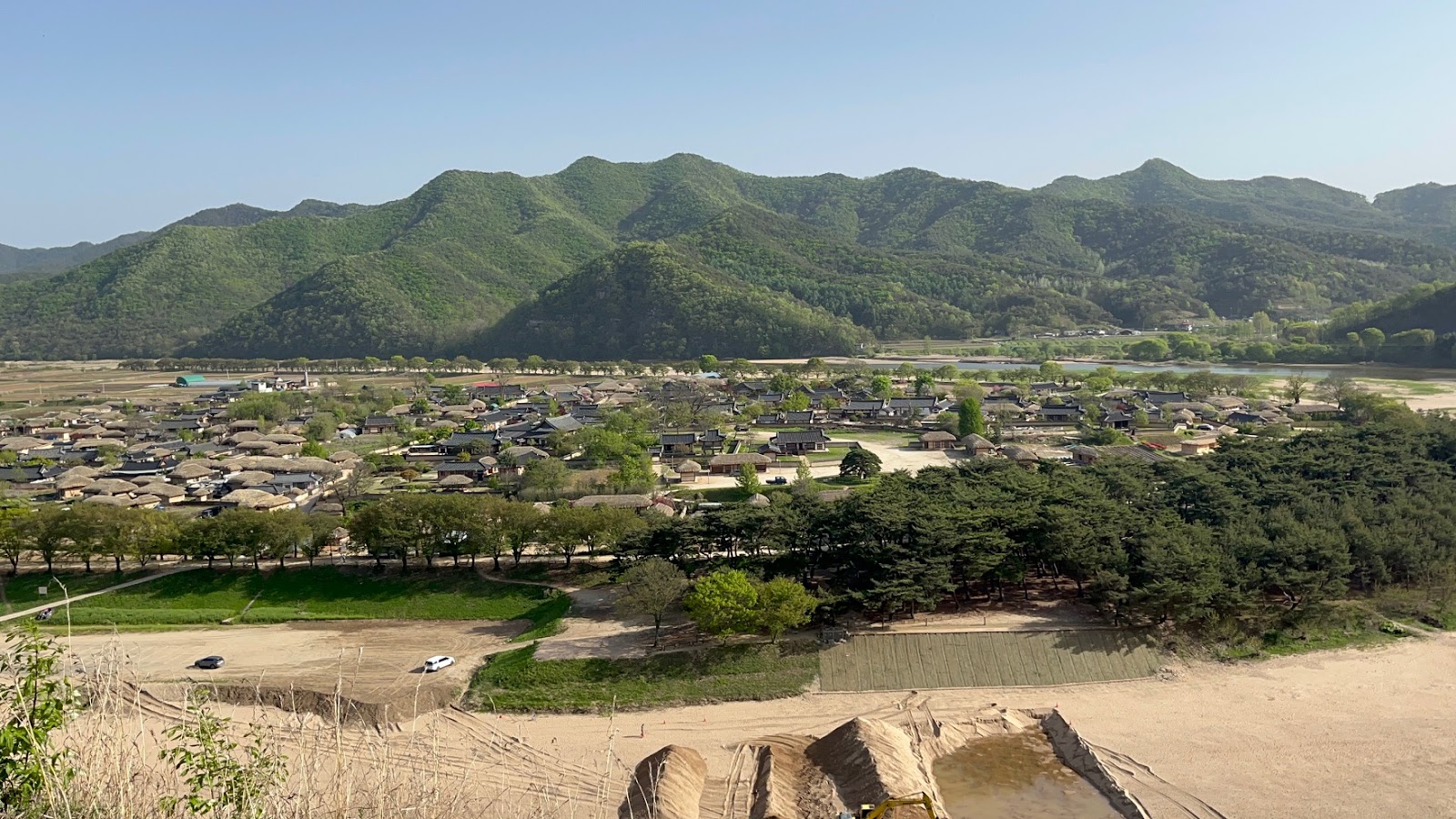
View from the local mountain top ( a bit of a hiking trek) to see the vastness of Hanael Village.
Our group for a photo at the top of the mountain trek!

Left to Right. Dr. Paul M, Baek Lym (Nation’s Treasure Painter), Malinda M, Gail Pickens-Barger, Zuzana N, Linda B, Mr. Lee, Monica R and President of Seokmun Community, Kim Ok-rei. 

Our crew visiting the mountain top near Andong, South Korea to see the village's vastness.

Next up was the visit to the oldest temple in South Korea.  Here is some of the work that our local Seokmun practitioner from the Andong/Government center does for his living.  He restores painted works for the temple, located near Andong.  Which holds the oldest temple in South Korea.
Underneath the varied temple building at the oldest temple in South Korea.

It is really like a mandala, what we see in yoga a lot.  Very vibrant and colorful.

So we really got our high intensity workout that day, look at these stairs!  Apparently, we just missed the festival being held at the temple the previous week.

The little bit of a stair case up to the temple.  Near Andong, South Korea.
Underneath the varied temple building at the oldest temple in South Korea.
Festival sayings from the previous week, at the oldest temple site near Andong, South Korea.
Underneath the varied temple building at the oldest temple in South Korea.
At the oldest temple near Andong, South Korea.
Ring the bell.  At the oldest temple near Andong, South Korea.
Upclose engravings on the bell. At the oldest temple near Andong, South Korea.
At the oldest temple near Andong, South Korea.
Wide angle shot.  At the oldest temple near Andong, South Korea.
Bang on the drum. At the oldest temple near Andong, South Korea.
A start of a rock pile, tower. At the oldest temple near Andong, South Korea.
Inside of one of the temple buildings. At the oldest temple near Andong, South Korea.
Dragons protecting the contain at the Dan-Jeon.  At the oldest temple near Andong, South Korea.

Two dragons facing off and as the artist explained (if you look closely there is a ball of energy formed above their fiery exhale).  The artist explained this is the Yeo-ui-ju  that is formed when their energies meet.  I thought it was pretty cool, though it had faded.  

We additionally went to the Gumi Center with teacher/leader, Cheon Moon.  We had tea time, and a practice.  The warm up at the Gumi Center was different, as was the recovery session different from the standard warm up/recovery methods.  We were also fed a meal by the community members from Gumi.  My favorite was the radish garnish with herbs and mushrooms.  
One of our typical breakfasts/dinners. At the Andong Main Center.

Linda and Malinda were asking Grand Master different aspects of the postures, and Grand Master demonstrated the movement based dance, by what energy he could feel in a song/musical piece.  He taught us some techniques in movements.  I really enjoyed that particular session.

We had a round table discussion with the Gumi community members.  A lot of the members were Level 14s!  After a lively discussion, we did a main practice meditation session.  I encountered a bit of sleep paralysis, which I’ve had before in the past.  

When we came back to Andong, Zuzana and I stayed in the VIP room at the hotel.  It included a nice massage chair, which we both enjoyed.  We were to move to a different room the next day.

From the hotel room in Andong, South Korea.

Day 5 – Workshop, Lunch, workshop, checkup Dinner, Class lecture.   Saturday – April 20, 2024.

Workshop started at 9 am on Saturday.  I did Level 1, Level 2, Level 1 with the main practice meditation.  Teacher Mu-Hye did the diaphragmatic massage for me on that day. We had lunch.  Enjoyed a Tea Meditation.  This is similar to the Noting and Labeling meditation we do in my advance yoga training with Lex Gillan at the Yoga Institute in Houston, Texas. I think though I like the Seokmun variation better than the Noting and Labeling technique.

Our members from the US talked about continuing the Tea Meditation practice on a regular basis.  I made note of the type of container that one makes the tea from.  The center also had a container to store the tea in, for the tea meditation refilling process.  If some of us are doing the tea meditation online, then one would need to acquire some similar type of container, in order to continue to fill one’s cup.  I’ve used a tall hot drink dispenser, when I’ve provided tea for my students.

After the tea meditation, I did Level 2, Level1, and then followed the folks in front of me for a mixed level hang gong postures.  Several of the postures were from Level 5.  Some of them were postures that I already knew from my yoga practice.  Specifically East to West posture, and Plough posture.  Level 5 Poses, #1, #2, #3, #4.  Level 6 Poses, #4, #5.  Level 8 Poses, #4, #5.  Level 10 Poses #1.  I wonder if this particular set of poses (some were repeated) are done different times of the year?  Or for a specific purpose during an in-person workshop day. 

We did Lying, seated and lying meditation, and accumulation.  We then had a checkup.  I was promoted to Level 3, during my checkup.  I was not expecting that.

After dinner, we were given some gifts from the community, traditional geese, and a Korean ornament, which is typically worn on a hanbok traditional Korean outfit.

We then had a training session with the Grand Master, and took photographs with members and our participants.

Dr. Paul M and Mr. Lee received their Instructor certificate, level 3.
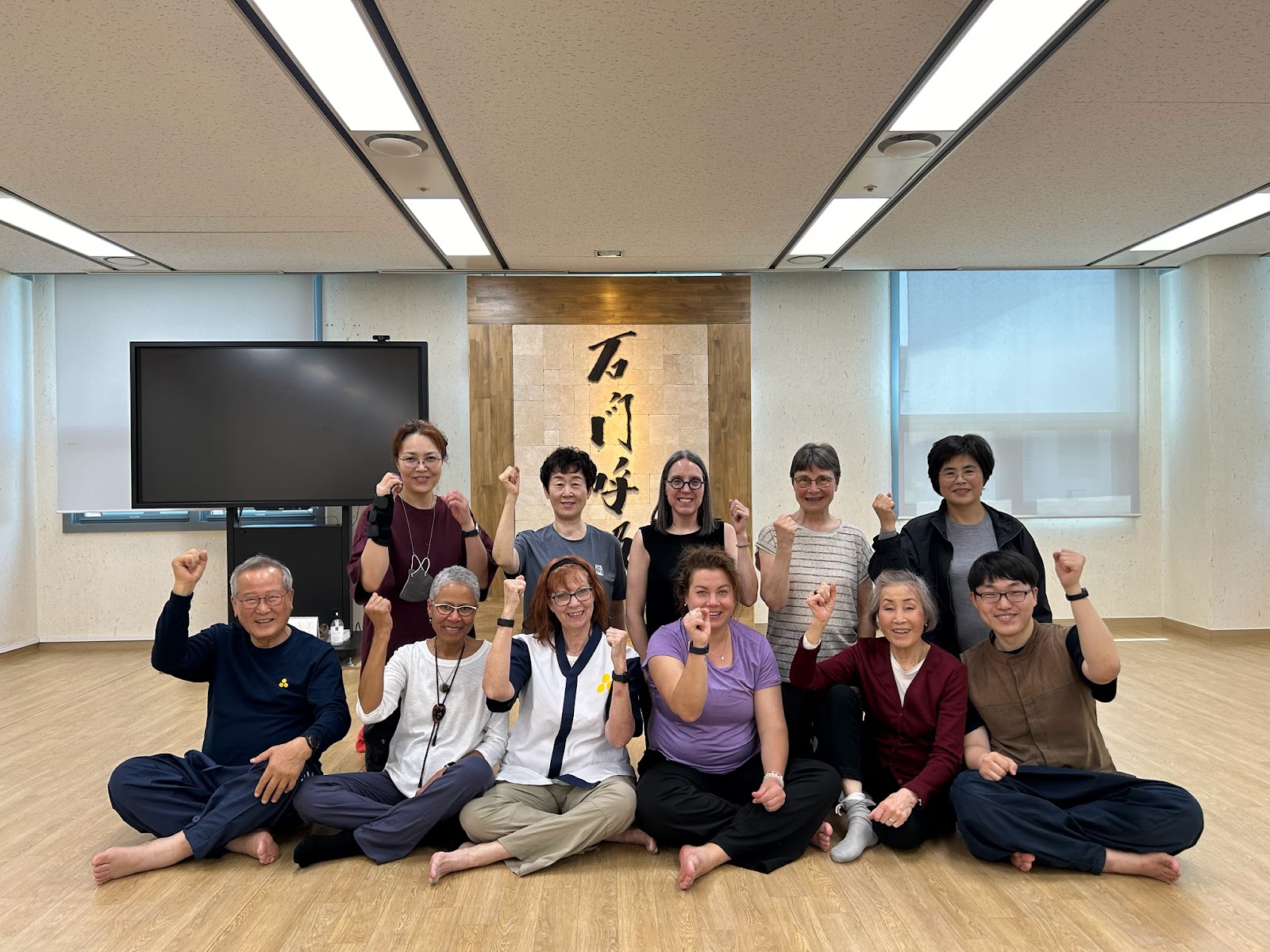
After our final training at the main center in Andong, South Korea.

Community members, US crew and teachers at Government Andong Center.
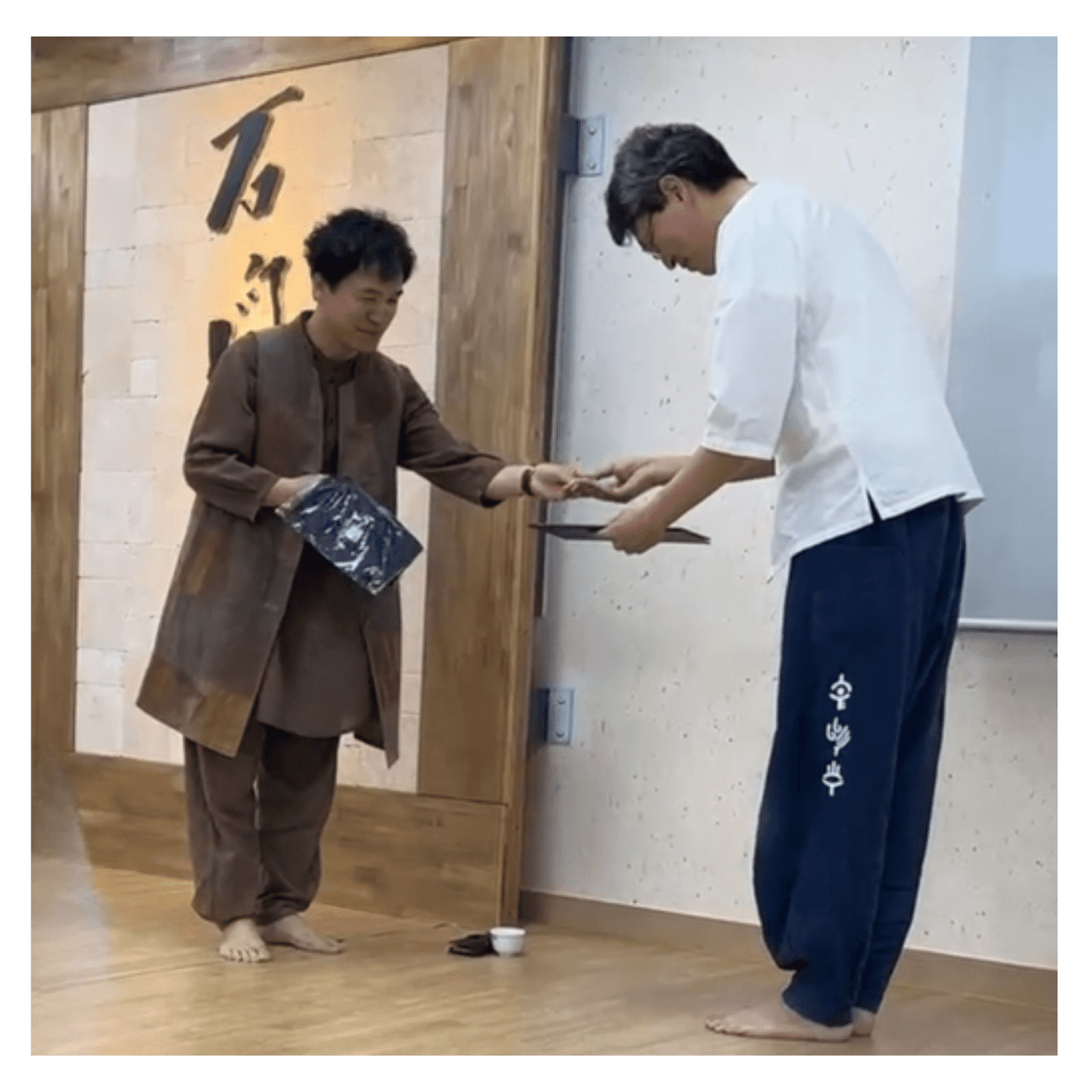
                Grand Master presenting Dr. Paul M Teacher Level 3 Award. Mr. Lee receiving Teacher Level 3 Award from Grand Master Cheon Pyeong Nim

Our community hosts at the main center in Andong, South Korea.

Kim Ok-rei, President of the member Seokmun Andong Community, Gaile PB, and Baek Lynn Nation’s Master Painter
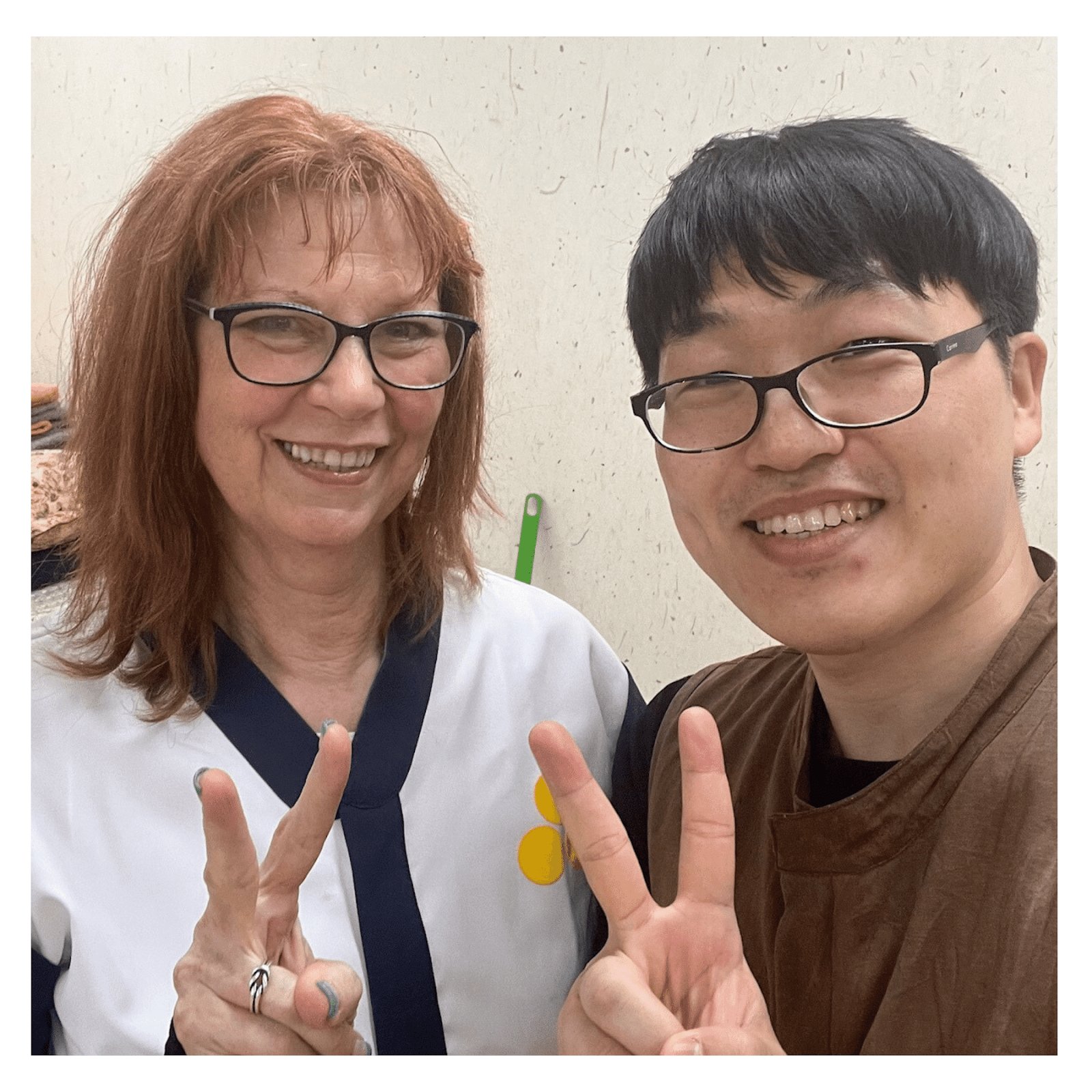
Top Teacher M-H at the main center in Andong, South Korea.  He is nearly the same age as my son!

 Gaile PB and Mu-Hye Andong Top Teacher

Grandmaster C P Nim at the main center in Andong, South Korea.

Cheon Pyeong Nim and Gaile PB

Tea time and snacks with the community members, Teacher M-H and Grandmaster C P Nim.

Hospitality from the Andong Community members!  Lovely!
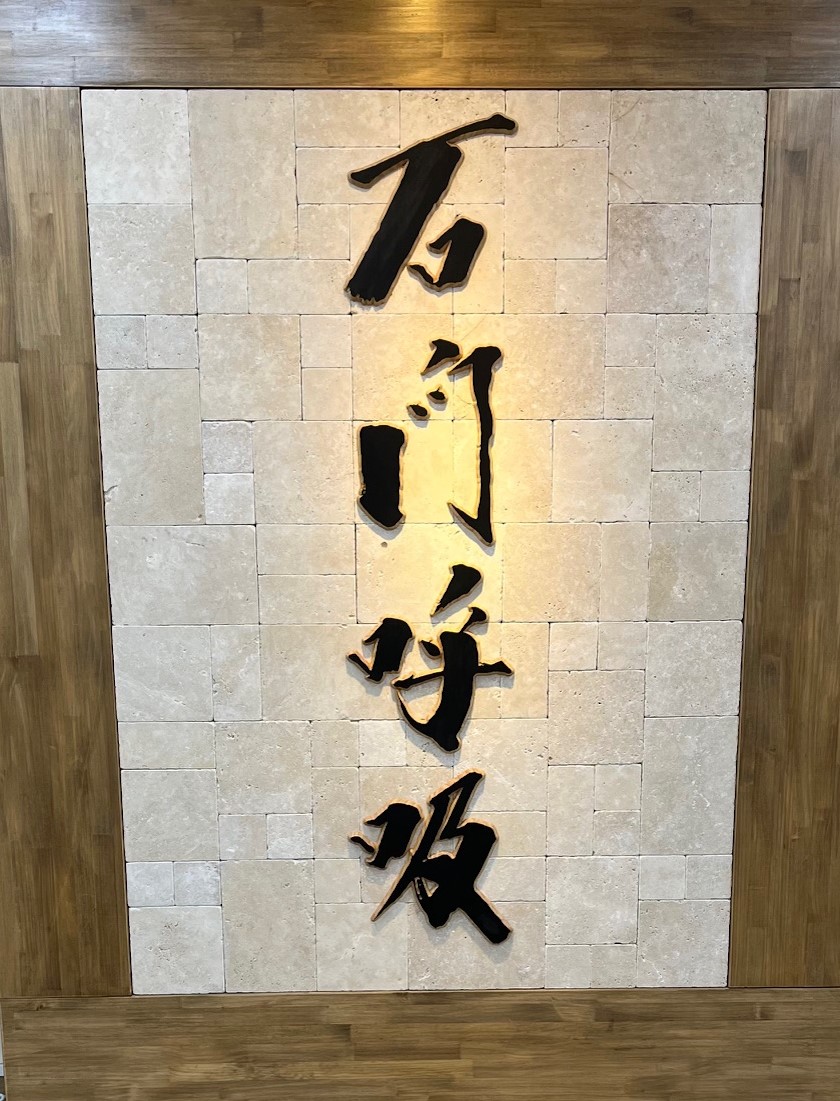
Seokmun Hoheup Breathing

Day 6 – Travel to Suwon.  Main Center, Publishing Building, North Suwon Center, then to Seoul Korea.  Sunday – April 21 2024.

We checked out of  the CM Park Hotel and left Andong in the early morning. Our kind community member drivers took us to the bus station. On the journey to Suwon we stopped along the way at a rest stop.  Some of our crew purchased food and novelty items, then the rest of the bus trip we enjoyed the mist-filled hills that lined our path.
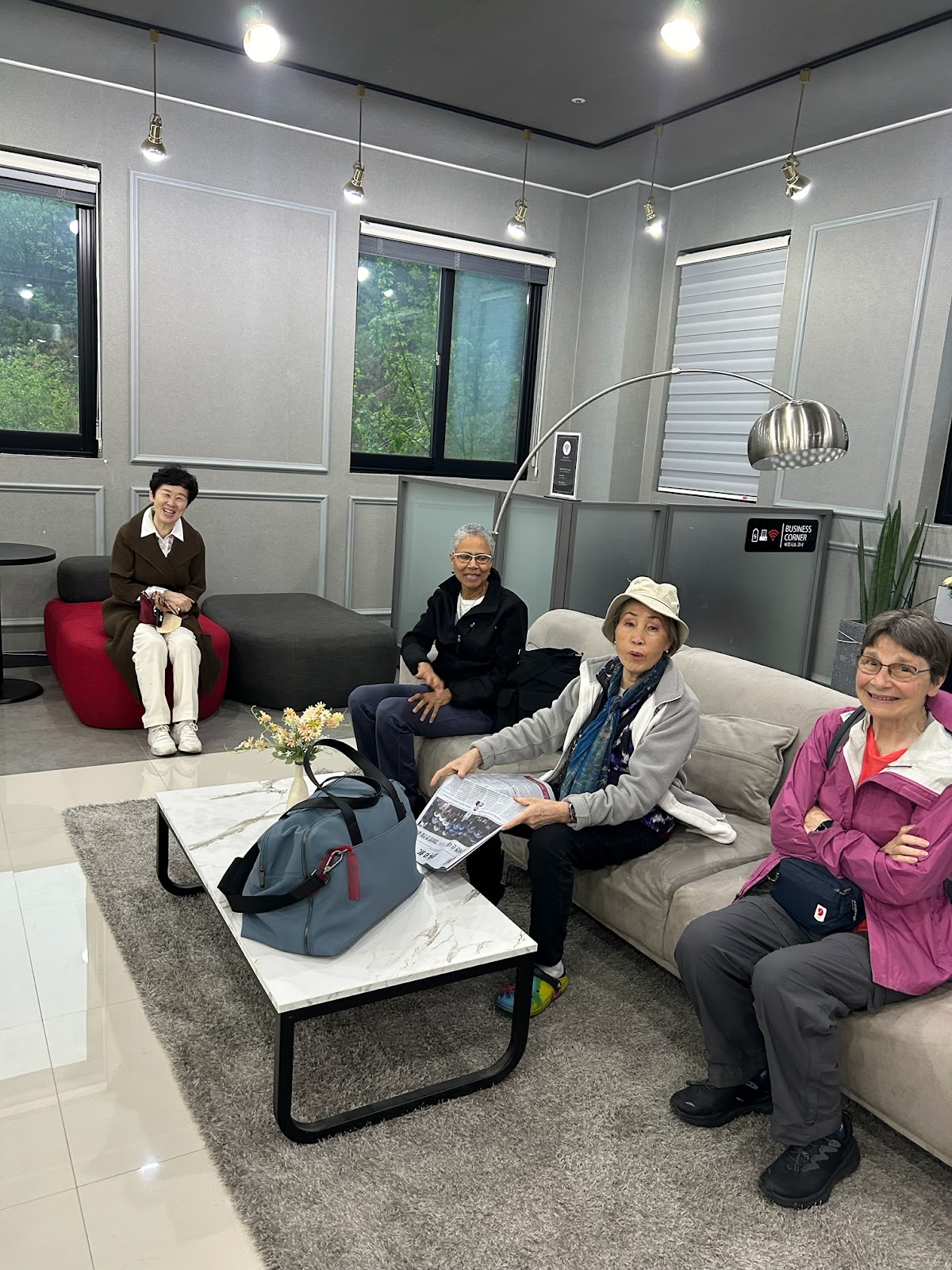
Getting ready to leave for Suwon, Andong.
Last minute chair massage!  Park DM Hotel, Andong, South Korea.

Waiting for our transportation to the Bus, to travel to Suwon.  Getting a last minute massage!

Misty landscape on our way to Suwon, South Korea.  Riding a Bus.  Let's see.  A plane, a train, a subway and a bus, and finally a taxi!

Misty side of the road as we traveled to Suwon.

We arrived early to the city of Suwon and enjoyed some pastries at the Paris Baguette shop as we waited. At the appointed time, we took a taxi to the Suwon main center.  As it was Sunday, it was closed. We walked to the Seokmun-Hoheup publishing center, where we met with the other Grand Master from the North Suwon Center.  He led us through the neighborhood to the North Suwon Center. The roads were blocked, as there was a marathon run/walk activity going on in this part of Suwon.

Our visit included tea time chat, a tour of the North Suwon Center.  We received lovely gifts of tea service from the Cheon-Sang-Hwa Suwon Region Grand Master.  Additionally, we received specialized personal tea from the main center.  Very unexpected and made everyone feel welcomed and special.

Main Center Suwon, South Korea.
Main Center, Suwon, South Korea.
Walking to North Suwon Center, Suwon, South Korea.

I think Grandmaster Cheon Pyeong Nim was enjoying the heavy bags he volunteered to carry.  Building muscle!

We had a main meditation practice at the North Suwon Center. 

 It was such a lovely space.

Main room, North Suwon Center, Suwon, South Korea.
Participants in the main meditation practice at North Suwon Center, Suwon, South Korea.

Front Row. Zuzana, Mr. Lee, Monica, Gail, Malinda, Dr Paul M, Catherine & Linda.  Back Row. Grand Master Cheon Pyeong Nim, Cheon-Sang-Hwa Suwon Region Grand Master, and Su-Il Grand Master.

We had dinner in Suwon before departing to Seoul, South Korea in a taxi ride.  

Day 7 – Activities in Seoul Korea.  Monday – April 22 2024.

Several of us in our group had activities to attend to in the morning.  Most of us came together to go eat Udon noodles.  Took the subway to get to a different neighborhood.  Several of us walked the neighborhood to do some tourist shopping.  

We gathered later on and took the subway to visit the Hyundai Shopping Center.  Being in the big city, going to the mall, seemed to me so different from being in the city of Andong.  Similar to here in the US, a big city like Houston, Texas has the energy of that type of town, compared to where I live in the Port Neches/Nederland/Beaumont Texas area, a small town community feeling.

Back to the AirBnB, attempting to do laundry.  Linda and Malinda spent a bit of time with me, going over Level 3 posture questions that I had.  I was able to take my notes from the US workshop that the Grand Master gave in Minnesota, along with what I have read in the big book.  Linda and Malinda were able to supplement my knowledge to where I feel confident in the poses.  

After the visit to the mall, our group came together for a discussion about Seokmun-Hoheup and spent a bit of time writing thank you notes to our hosts. I had a great discussion with Catherine about the history of the Korean peoples.  I’ll be writing up those notes in a separate summary.
 

Local photograph in Seoul, South Korea.
At the AirBnB in Seoul, South Korea

At the AirBnB in Seoul, South Korea

Day 8 – Leaving Seoul, Korea.  Arriving in Minnesota/Houston, Texas.  Tuesday – April 23 2024.

Zuzana left first early in the morning, Catherine was picked up by her brother at 11 am, our checkout time, and the rest of us headed to the subway, to take us to the airport for departure.  Dr. Min accompanied us to the airport.  We were a bit early for check in, so we gathered with the remaining people for a great lunch.  

There is a bit of construction going on in the airport.  Malinda and Linda accompanied me to my departure gate, as I was leaving a whole hour earlier than they were leaving.  It was a very long flight on the way back.  I had a decent seat, and was able to get up, even with being the middle person in the middle section.  My airplane companions were Chinese.  My right sided companion had a physical translator device.  He had fun conversing with the device.  My right sided companion was fluent in English.  I had checked a bag, as I was bringing it as a carry on the hangul typewriter to take back to the states.  

Getting back to Houston, came the way of a stop in Atlanta, Georgia.  I had to take the airport train, to get from the international location to the domestic flights location.  Customs went by very fast, and I had to pick up my checked baggage and basically put it onto a transfer baggage location as I was getting ready to do another security check.  The typewriter as it went through security, raised some eyebrows.  Even though typewriters were still popular in the 1980s, 1990s, a lot of the people I encountered did not know about the manual typewriter.  I was able to board my Atlanta flight early, as I needed extra time to safely load the typewriter in the overhead bin.  

I got to my home, after a 2 ½ hour drive at about 3 am in the morning.  It took me several days to get back onto my normal schedule.  As I write this section of the summary I am a week and 3 days since coming home from the experience.  I still have some trouble sleeping and getting back into my routine.  My youngest child is also in their last weeks of school, getting ready for the university, so normal end of the school year activities are different with them graduating.

Being as I do the Seokmun-Hoheup movement and breathing practice remotely from the US team, I was able to enhance my experience with the Korean workshop with the different teachers and centers.  It became apparent to me, my lack of understanding of some of the physical differences in the postures.  

Additionally the placement of the dantian tape was a bit different in how I placed the tape.  Being in the presence of a teacher, also helped with the letting down of my thoughts in helping me to focus and concentrate on the Seokmun Point.  Being in a room with others who have gone before me in their different levels, also enhanced the experience.

My experience probably is a bit different than those who regularly met with Dr. Paul M and Ben K.    I additionally teach in-person classes with my chair tai chi and the yoga classes that I teach.  For over 4 years now, I have also taught online using the Facebook, Mind Body Online, Wellness Living and Zoom online platforms.  Not all online experiences give one the ability to grasp the subtle details of learning, doing the poses.  Great experience to do Seokmun-Hoheup in person with a community of like minded folks.  Thank you!

Submitted for review.  Gail Pickens-Barger. NACYT-500, E-RYT 500, Certified Yoga Teacher. Experienced 500 Teacher Level. Twenty-four years teaching, kids, adults, seniors, chair and adaptive populations.   May 3, 2024
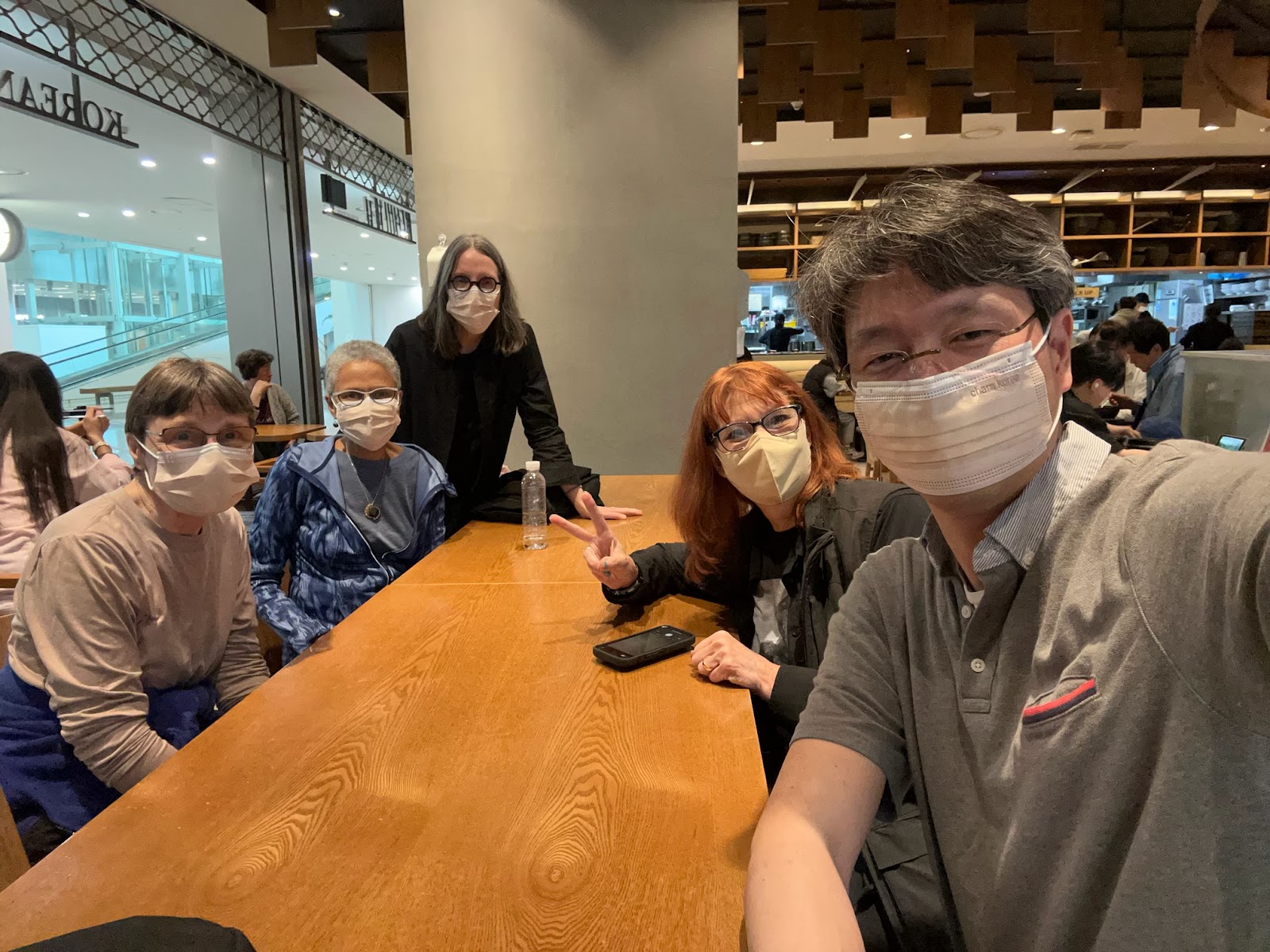
Korean Restaurant at the Incheon International Airport, Incheon, South Korea.

Korean restaurant at the Incheon International Airport.  All masked up and ready to go!

Seokmun Hoheup is a comprehensive practice rooted in movement and breathing, designed to foster physical and mental well-being. This approach incorporates specific postures and breathing techniques that aim to promote mindfulness, inner stillness, and a sense of energy flow throughout the body. The practice involves focusing on the dantian point, which is believed to be a crucial center for energy cultivation.

As part of the Seokmun Hoheup practice, individuals are guided through various levels of postures and breathing exercises, each designed to deepen awareness of the body and breath. Additionally, the practice emphasizes the placement of Dantain Tape, which may aid in facilitating a more focused and concentrated practice by guiding the practitioner’s attention to the Seokmun Point.

The practice is often undertaken in a communal setting, where practitioners can benefit from the supportive energy of a like-minded community. Through shared experiences and interactions with others who have also progressed through different levels, participants can enhance their understanding and application of the practice.

The underlying philosophy of Seokmun Hoheup centers around the idea of achieving a harmonious balance between physical, mental, and spiritual aspects of well-being, seeking to enrich each practitioner’s journey towards greater self-awareness and holistic health.

Overall, Seokmun Hoheup breathing practices offer a unique approach to personal growth and self-discovery, complemented by a supportive community and guided instruction.
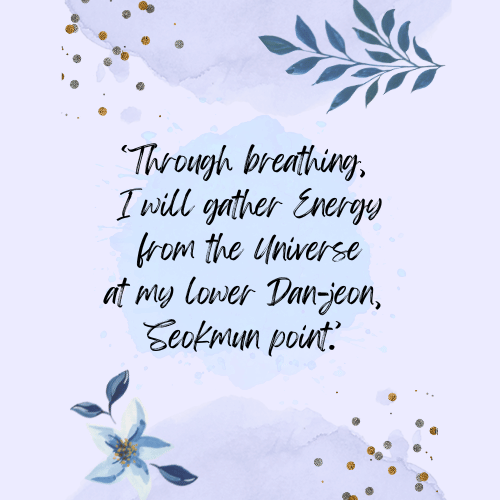
Logo for Seokmun Hoheup Practices & Main Meditation. Through breathing, I will gather Energy from the Universe at my lower Dan-jeon, Seokmun point.’
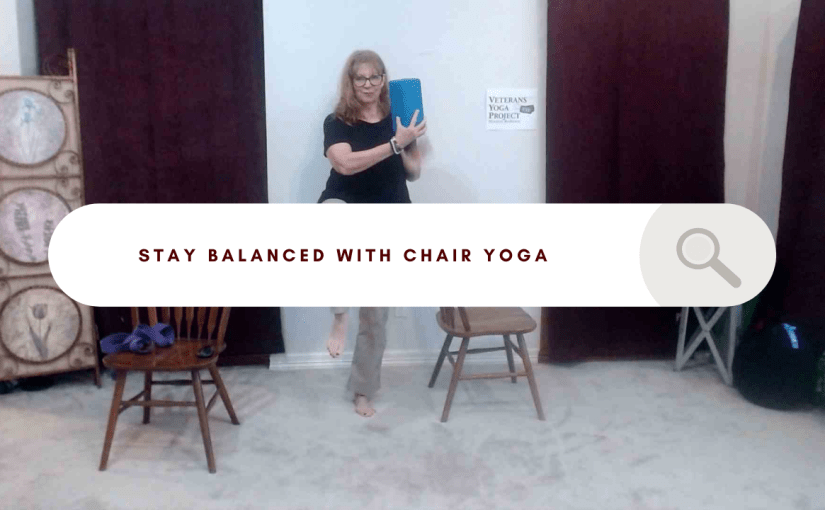
Seokmun Hoheup Practices & Main Meditation. Through breathing, I will gather Energy from the Universe at my lower Dan-jeon, Seokmun point.’

Yoga and Kids Photography by David C. Turnley

Gail demonstrating "Snake" or Cobra Pose in the YogaKiddos Class at Wesley
Gail demonstrating “Snake” or Cobra Pose in the YogaKiddos Class at Wesley
YogaKiddos teacher, Gail Pickens-Barger demonstrating - Active "Flamingo" balance pose in the YogaKiddos class.  Photography by David C. Turnley
Active “Flamingo” balance pose in the YogaKiddos class. Photography by David C. Turnley
Grace and Gail demonstrating the "big breathing" technique in our YogaKiddos Class - Photography by David C. Turnley
Grace and Gail demonstrating the “big breathing” technique in our YogaKiddos Class – Photography by David C. Turnley
Miss Rachel and Gail demonstrating "Giraffe" Pose in our YogaKiddos Class - Photography by David C. Turnley
Miss Rachel and Gail demonstrating “Giraffe” Pose in our YogaKiddos Class – Photography by David C. Turnley

Additional beginners yoga classes for back challenges with Gail P-B.

For those of you taking my online beginning yoga classes, I’ve include a few fan favorites here for you to enjoy. Additionally, a Yoga Nidra Meditation & Chair Tai Chi with Gail PB.

Hello, I’m providing some links to previously recorded classes, in case you need to take another class with me, prior to us coming together next Wednesday. I teach regularly on Wellness Living Online Studio classes for Veterans Yoga Project. Enjoy!

Videos:
https://youtu.be/RrhmFnQ18vA

I’m also including a seated chair tai chi video:

and lastly a 43 minute Yoga Nidra practice, which in my opinion is part II in reducing chronic daily pain.

Prenatal Yoga in Mongolia

I presented a Prenatal Yoga class in Avraikheer, Mongolia, while I was visiting Amber (who was in the Peace Corps) in 2009.

Mongolians have this superstition about being on the floor in public, so they laid a blanket on the floor so that I could demonstrate Cat/Cow flow.

I then proceeded to demonstrate the rest of the poses standing, with the chair, or with the wall. Talk about a change of plans! Good thing I had come up with a alternate flow for doing prenatal yoga in chairs!

Now they want me to prepare a handout, so that they can take it at home and practice at home. Amber and I are working on that information, and it will be translated into Mongolian.

I had a midwife there also, and she was supplementing the things I was trying to say, for poses that you do during labor, with her expertise too. Great presentation!

Yoga brings unlikely yogis – article from the Port Arthur Newspaper

September 8, 2011

Port Arthur News article about…..Yoga brings unlikely yogis

NEDERLAND — At the end her class, Nederland yoga instructor Gail Pickens-Barger asks her students to mediate on how they are unique and “there is nobody like you in the universe.”

Her students suffer from multiple sclerosis, a chronic, unpredictable disease that effects the central nervous system, and none of their symptoms are exactly the same.

Some of her students experience episodes extreme numbness in their limbs.

“It is as if you put a giant foam block around your leg or foot,” Pickens-Barger said.

For some, the disease effects their balance or, in Crystal Chauvin’s case, a day-long jolt of electric pain down her cheek.

All of the students seem to share in one thing: The relief and relaxation of yoga.

“It helps me move better, helps me balance,” said Becky Dry, who has dealt with the disease for much of her life.

“The class helps us get through the day,” added Dry. “I’m ok now but tomorrow I may not.”

Approximately 400,000 Americans suffer from multiple sclerosis and every week 200 more people are diagnosed with the disease, according to the National Multiple Sclerosis Society.

There is no known cause or cure for MS. It is only fatal in extreme cases.

MS adaptive yoga is done in chairs for safety but, as Pickens-Barger points out, it can still make you sweat.

“Keep it between easy and ouch,” Pickens-Barger said during one of the stretches. “Far, far away from ouch.”

Pickens-Barger just got back from a two week long chair-yoga training in New York City, where she learned new techniques to allow her students to access the benefits of yoga without completely exhausting their bodies.

One of the biggest problems for people who suffer from MS is balance. Most of the students use a cane or a walker to get from one place to another.

The yoga techniques are designed to strengthen a person’s core muscles which help them balance whether they are sitting down or standing up.

Just as important as the benefits of the exercise and strength-building, is the sense of community and friendship the class brings to each other’s lives.

“It’s a support group also,” said Pickens-Barger.


Yoga for Multiple Sclerosis for the National MS Society.  Local teacher, Gail Pickens-Barger, teaches adaptive yoga for NMMS
Yoga for Multiple Sclerosis for the National MS Society. Local teacher, Gail Pickens-Barger, teaches adaptive yoga for NMMS

Lonestar National MS society sponsors the class as well as a 180-mile bike ride from Houston to Austin for cyclists living with multiple sclerosis.

The yoga classes take place online through Gail’s Youtube channel for the Wesley United Methodist Church in Nederland.  The local branch of the Multiple Sclerosis society meets the first Saturday of every month at 11 a.m. at the Medical Center in Port Arthur.

bjanes@panews.com


Yoga for Multiple Sclerosis for the National MS Society.  Local teacher, Gail Pickens-Barger, teaches adaptive yoga for NMMS
Yoga for Multiple Sclerosis for the National MS Society. Local teacher, Gail Pickens-Barger, teaches adaptive yoga for NMMS

Salute the Sun, Sun Salutation yoga practices with Gaileee in Nederland Texas and Beaumont Texas

I teach a simple version of the Sun salutes, Salute the Sun, Sun Salutations in the yoga class on Fridays at Lakeside Center in Beaumont, Texas.

SunSalutesWithGail
Salute the Sun, Sun Salutations, a set of yoga poses most commonly called the Salute to the Sun, or Sun Salutations in Nederland, Texas with Gail Pickens-Barger.
Over 19 years of teaching experience.  Call 409-727-3177 and leave a voice message on your yoga questions.

Kids Yoga Day – April 5, 2024

April 5th, 2024 is the 9th Kids’s Yoga Day Event. Held the first Friday in the month of April.

Just 5 minutes of yoga a day can boost the mental and physical health and wellness of our children, regardless of their socioeconomic status, athletic abilities or prior knowledge. To help spread this powerful message, in 2016, Teresa founded Kids’ Yoga Day (KYD), an international event held every year all over the world – at schools, homes, yoga studios, and/or community centers, even via livestream!  No previous yoga experience required.

Come to class. Starts at 10:30 AM!

In 2023 over 435 yoga ambassadors from 36 countries and 43 states, led over 30,000 children through a simple 5 minute routine at the same time, on the same day, not to mention countless others following along at home.

Our participants reported that the kids not only loved doing yoga, but also being a part of something bigger than themselves.  In this frenzied world, isn’t that what it’s all about?

Last year Teresa created an adaptive yoga routine, from a suggestion that I had made the previous year. I used the routine for the seniors that I teach on Fridays! They LOVED it!

Adaptive Yoga Kids Yoga Day . Suggested by Gail Pickens-Barger, a Kids Yoga Day ambassador. Teresa created this routine to use starting in 2023!

The 9th Kids’ Yoga Day is happening on Friday, April 5th, 2024. 

Back Challenges – Easy Yoga for Back Relief

Overview of Back Care Yoga Class

Easy to do yoga movements, today’s class featuring postures for easing sciatica & kyphosis. Class will also promote healthy backs!
  • Gail teaches gentle yoga for back care, focusing on low back, upper back, mid-back and core.
  • Specific yoga postures are designed to ease back challenges and chronic daily pain.
  • Equipment needed: yoga strap and yoga block, although not mandatory for participation.
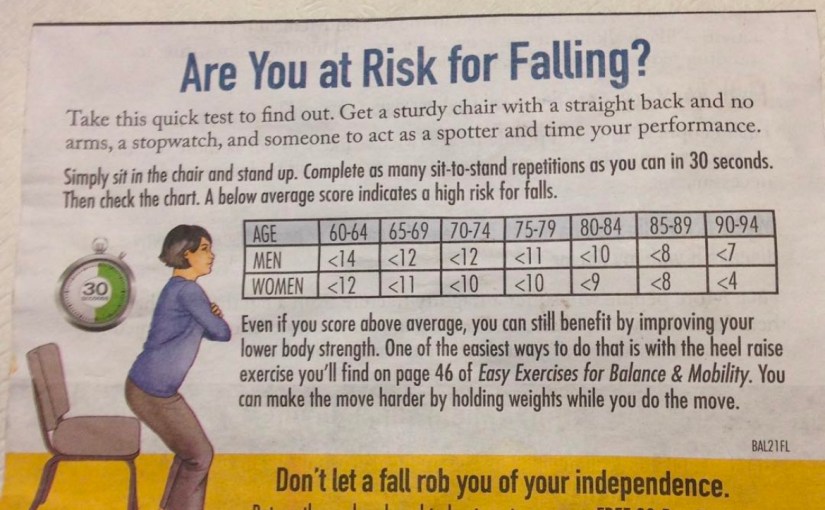
  • Recording of the class is provided for those who want to try with the gear later.
  • Class ends with guided rest, relaxation, and gratitude practice.

Adaptations for Different Needs

  • Participants can choose to stand, sit on a chair, or modify postures based on individual needs.
  • Constructive rest posture is recommended for reducing back challenges.
  • Seated Participants can also benefit from certain postures, with some adaptations required.
  • Various modifications are suggested to accommodate different levels of flexibility and comfort.
  • Participants are encouraged to listen to their bodies and adjust postures accordingly.

Yoga Postures for Back Care

Yoga postures for back care are specific poses designed to strengthen and stretch the muscles in the back, helping to improve posture, reduce pain, and increase flexibility. These poses target different areas of the back to promote overall spinal health and alleviate discomfort.

Constructive Rest Yoga Posture for Easing Back Pain.
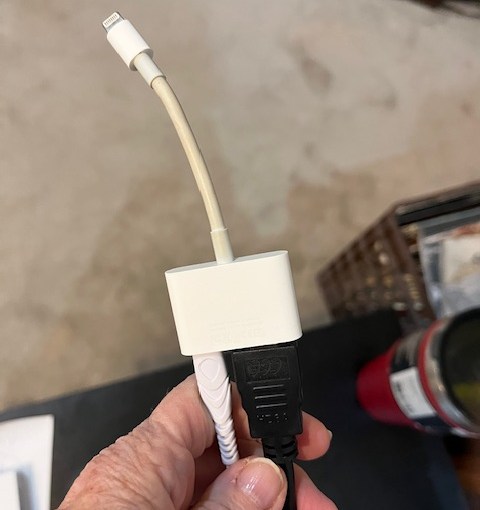
Knee to  Chest Sequence for Easing Back Pain.  Yoga with Gail
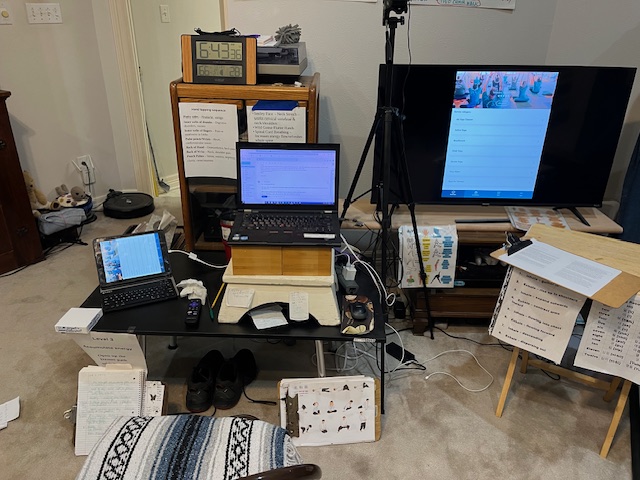
Easing Back Pain with Overhead Extension Yoga Pose Sequence with Gail PB
Flowy Cat Cow Sequence Yoga Posture for easing back pain with teacher, Gail PB
Warrior Pose Variations for strength and lengthening of the lower body muscles.  Yoga with Gail PB
Unsupported Spinal Twists and Bird Dog Spinal Balance Variations for easing back pain.  Yoga Teacher Gail PB

Sciatica can be a real pain in the butt!

Check out my latest YouTube video to see if this beginners yoga class can ease some of your sciatica challenges. Always listen to your body, keep it between the easy and the ouch!

Easy to do yoga movements (poses or postures) for back relief. Today’s video features postures to easing sciatica and lessening kyphosis with a regular practice. Join Gail PB as she teaches this Beginners Yoga Class. Note: Can be done seated on the chair, or on the floor with your yoga mat.

Sciatica can be a real pain in the butt! Sciatica symptoms can be caused by compression of the sciatic nerve as it runs through the pelvis, adjacent – or sometimes through – the piriform muscle (Sciatic nerve entrapment, also called piriformis syndrome.) Sometimes the pain is localized in the butt, although it an manifest in different ways all the way down to the toes due to the branding nature of the sciatic nerve.

Favorite Yoga Poses from Summer 2009


So here I am in the Gobi desert in Mongolia, and you might say, I’m doing an excellent “Camel” pose.  Really trying to stay *on* the camel, that is…..

A photo of one of the Buddhist temples in the ancient capital city of Mongolia, Harhorin.

Photograph looking outwards from the Horse monument, just outside the city of Avairhkeer, Mongolia.

Lotus pose, near one of the demolished Buddhist temples several hours outside the current capital of “UB” Mongolia.

Warrior II with an obu (stone pile) in the background.

More can be seen on my Mongolian blog at
http://gaileeeadventure2mongolia.wordpress.com/

Lotus Festival Lovelies


Lotus Festival Lovelies!

Lotus Festival Lovelies!

Celebrating teaching for 24 years!

Hey y’all, this is the 24th year for me to teach some type of yoga on this planet Earth!

Seated Chair Tai Chi with Gail Pickens-Barger

I’m celebrating by providing a free online zoom class of Seated Chair Tai Chi!

February 7th, 2024 at 11 AM Central Time.

Here’s the registration link. Love to see you in class for this new fitness class that I currently teach!

Chair Tai Chi registration link:
https://us06web.zoom.us/meeting/register/tZwrdu6uqjgqE9weVSeTXO2DIRV8z_gINoLr

Chair Tai Chi with Gail PB.  Free online zoom class on February 7, 2024 to celebrate my 24th year of teaching!
Chair Tai Chi with Gail PB. Can ya dig it?

Yoga for Back Pain Relief

Yoga for Back Pain Relief, Chronic or Recurring Back Pain
(shhhh, it’s yoga!)

Relief for Chronic or Recurring Back Pain (shhhh, it’s yoga!)

Instant Stress Eraser The economy is in the dumps. Gas prices continue to shoot upwards.

It’s winter. It used to be vacation time. If only you can take a vacation from stress.

Now you can. Right now while you read this post.

Sit up straight and take a deeper breathe than you normally do. Hold it for a second or two, and let the air out with a sigh. Go ahead. No one will notice.

Now, do it again. Take a deeper breathe than before. Hold it for a moment or two and just… let … it … go.

Most people tend to breathe very shallow in their chest. Shallow breathing promotes stress and tension. Deep breathing melts it away.

In a few minutes of deep breathing, you can actually eliminate all stress and tension, lower your blood pressure, and instantly gain a lot more positive attitude.

My name is Gail Pickens-Barger and I teach yoga Online/In-Person and Classes on YouTube. Forget what you’ve heard about yoga. You do not have to twist yourself into a pretzel to do yoga. It’s for everyone. Whether you are in shape or not.

And the benefits are immediate.

It’s winter so this is the best time to get started eliminating your stress with yoga.

Check out my latest beginner yoga video on YouTube:

Get back pain relief through gentle yoga with Gail P-b.

Gail Pickens-Barger Yoga Teaching Schedule

Gail's Yoga Teaching Schedule, online and in-person classes.
Gail’s Yoga Teaching Schedule, online and in-person classes.

Needing back pain relief?  I have two in-person classes, and one weekly online class to start you down the path of pain relief.

Student Testimonials

Health Benefits of Yoga

Gail's Yoga Teaching Schedule, online and in-person classes.
Gail’s Yoga Teaching Schedule, online and in-person classes.
Join Gail for Yoga & Chair Tai Chi at Beaumont Texas's Lakeside Center!
Join Gail for Yoga & Chair Tai Chi at Beaumont Texas’s Lakeside Center! 🧘_♀️ (3)
  • Questions?  Call Gail Pickens-Barger at 409-727-3177  Leave a message, this is a landline.

#VYPfamily #vetgratitude #prayergardenyoga #outdooryoga

Yoga Photographs by David C Turnley

David C. Turnley Photographer. Yoga with Gail Pickens-Barger

David Turnley is considered by many to be one of the best documentary photographers working today. Winner of the Pulitzer Prize, two World Press Photos of the Year, and the Robert Capa Award for Courage, he has photographed the human condition in some 75 countries around the world.

Turnley was a Detroit Free Press staff photographer from 1980 to 1998. He was based in South Africa from 1985 to 1987, where he documented the country under Apartheid rule. He has been a dear friend of the Mandela family for the last thirty years and photographed Nelson Mandela and the South African struggle over these last three decades. He was based in Paris from 1987 to 1997, covering such events as the Persian Gulf War, revolutions in Eastern Europe, student uprisings in China, and the disintegration of the Soviet Union.
He has published seven books of his photographic work including his last, Mandela: In Times of Struggle and Triumph, from his extensive time over the last twenty-five years photographing the evolution of South Africa, and Nelson Mandela and his family.

David has Directed and Produced three feature-length Documentaries. The Dalai Lama: At Home and in Exile, for CNN; La Tropical, called by Albert Maysles “the most sensual film ever shot in Cuba”; and his recently released, four years in the making, epic story of Shenandoah, located in the tough coal region of Pennsylvania. Shenandoah, which is available to view on Netflix, was named by The New Filmmakers Los Angeles as “Best Documentary Film” and David was named “Best Director” for the year 2013.

David is an Associate Professor at his alma mater, the University of Michigan School of Art and Design, and Residential College. He studied filmmaking at Harvard on a Nieman Fellowship and has Honorary Doctorates from the New School of Social Research in New York and from the University of St. Francis in Indiana. He received a B.A. in French Literature from The University of Michigan and has also studied at the Sorbonne in Paris.

The proud father of two children, David lives with his wife Rachel and family, in Paris France.